By Mark Buraga, Independent SEO Consultant at Growth Engine PH
A senior partner at a 30-attorney boutique tells the room: “We can’t market under our bar rules.” Three associates nod. The marketing director, three months into building a content engine, freezes the work that afternoon.
That sentence costs the firm more than any actual violation would. Across the Philippines, the United States, the United Kingdom, and Australia, every framework permits the same content shape: dignified, factual, educational material with verifiable contact information. That happens to be the exact content shape AI search engines preferentially cite. The compliance bar and the AI-citation playbook converge on one bar. Boutique firms that miss this are not avoiding risk; they are forfeiting the only legitimate growth channel left to them while peers who read the rules carefully take the citation slots.
The “We Can’t Market” Conversation Most Boutique Partners Have Heard

“We can’t market under our bar rules” is one of the most expensive sentences a senior partner can pass to a junior partner in 2026, because the rules permit exactly the content shape AI engines preferentially cite.
The conversation usually happens over coffee or in a partnership meeting. A senior partner raises a marketing initiative and says some version of: it is not how we operate, the bar takes a dim view, we built this firm on relationships. The room defers. The initiative dies or shrinks to something safe and bland enough to clear the imagined regulatory bar.
The problem is not the caution. The problem is that the cautionary statement is almost never accompanied by a specific rule citation, and the rule, when read against the page, almost never says what the partner remembered. The senior partner is reading a rule from memory, and the memory is twenty years old. Current frameworks were written or rewritten with explicit recognition that professional services firms operate in a digital era. They prohibit specific things: false claims, misleading communication, in-person solicitation of strangers in vulnerable circumstances, paid endorsements that misrepresent independence. They permit a wide zone of dignified, factual, educational content. That permitted zone is the live opportunity.
What Four Regulatory Frameworks Actually Say

Across PH CPRA, US ABA Model Rules, UK SRA Code of Conduct, and AU Solicitors’ Conduct Rules, every framework permits the same content shape: dignified, factual, educational content with verifiable contact information.
Reading the texts side by side surfaces the convergence faster than most partners assume.
PH, CPRA Section 17 (April 2023)
PH CPRA Section 17 explicitly permits dignified, verifiable, factual advertising by lawyers, including biographical data, contact details, fields of practice, and services offered.
The Philippine Code of Professional Responsibility and Accountability (A.M. No. 22-09-01-SC, promulgated April 11, 2023) governs lawyer advertising in Section 17. The rule states that a lawyer shall not advertise legal services except with the use of dignified, verifiable, and factual information, including biographical data, contact details, fields of practice, and services offered. The rule prohibits self-laudatory content and paid endorsements. Read literally, it does not ban marketing; it specifies what marketing must look like. CPRA is the most recent of the four frameworks and the most explicit about what is permitted.
US, ABA Model Rule 7.1 and 7.2, plus California SB 37 (2026)
ABA Model Rule 7.1 prohibits only false or misleading communication; Rule 7.2 explicitly permits advertising through any written, recorded, or electronic medium, with contact info required.
ABA Model Rules govern attorney advertising across most US jurisdictions. Rule 7.1: a lawyer shall not make a false or misleading communication. Rule 7.2 grants the explicit permission: a lawyer may communicate information through any written, recorded, or electronic medium, provided the firm’s name and at least one lawyer’s office address appears. Rule 7.3 bounds direct solicitation: no in-person, live phone, or real-time electronic solicitation of strangers, with carve-outs for current and former clients.
California added a sharp new layer. Senate Bill 37, effective January 1, 2026, requires every law-firm website, landing page, paid search ad, and paid social ad to disclose office location and the name of the responsible attorney. Penalties run $5,000 to $100,000 per violation, with a 72-hour takedown window. SB 37 tightens transparency; it does not ban advertising.
UK, SRA Code of Conduct Paragraph 8.9
UK SRA rules prohibit only unsolicited targeted approaches; non-intrusive, accurate, non-targeted advertising (including blog content, social media, and search) is explicitly permitted.
The SRA Code of Conduct for Solicitors governs advertising in England and Wales. Paragraph 8.9 is the operative rule: a solicitor shall not make unsolicited approaches to members of the public, with the exception of current or former clients. SRA guidance is unambiguous: a firm may advertise on radio, television, billboards, in newspapers, online, or on social media, so long as advertising is non-intrusive and non-targeted at specific individuals. A blog post in search results, a LinkedIn longform article, a YouTube explainer, a Reddit comment from a named partner: none are unsolicited targeted approaches. All are permitted.
AU, Legal Profession Uniform Law and ASCR Rule 36
Australian Solicitors’ Conduct Rule 36 prohibits only false, misleading, deceptive, offensive, or unlawful advertising; truthful, factual marketing is explicitly permitted.
The Australian Solicitors’ Conduct Rules 2015 govern solicitor advertising. Rule 36 sets the boundary: a solicitor or law practice must not advertise in a manner that is false, misleading or deceptive, offensive, or prohibited by law. The rule further prohibits titles like “accredited specialist” without authorisation. Outside those prohibitions, truthful factual marketing is permitted across every medium.
The One Word That Authorises the Entire AI-Citation Playbook
The word “dignified” in PH CPRA, and its functional equivalents in the other three frameworks, is not a vague tone descriptor; it is a near-perfect specification of the content shape AI engines preferentially cite.
The convergence hides in plain sight. PH CPRA uses “dignified.” ABA Rule 7.1 uses “not false or misleading.” SRA uses “accurate and non-misleading.” AU ASCR Rule 36 uses “not false, misleading or deceptive.” Different vocabulary, same specification: content that is factually accurate, attributable to a named source, free of unjustified claims, substantive enough that a potential client can make an informed decision.
That specification reads almost word-for-word like the criteria AI search engines use to decide which sources to cite. AI Overviews, ChatGPT, Perplexity, and Claude all weight: named author byline, verifiable credentials, factual claims with inline citations, structured data, no exaggerated guarantees, third-party verification path. Each maps directly to a regulatory criterion.
| Regulatory criterion | AI-citation criterion | |—|—| | Dignified, factual (CPRA) | Substantive, structured | | Not false or misleading (ABA 7.1) | Verifiable factual claims | | Accurate (SRA) | Inline-cited | | Verifiable, biographical data (CPRA) | Named author with credentials | | No self-laudatory content (CPRA) | No unjustified expectations (matches ABA) | | Contact details required (ABA 7.2, CPRA) | Organization schema with NAP consistency | | No “specialist” without accreditation (AU ASCR, ABA 7.4) | AI ignores unattested superlatives |
This is not coincidence. Bar regulators and AI engineers arrived at similar requirements because both are solving the same problem: how does a reader, human or machine, tell credible information from noise. The answer is the same: named, attributable, verifiable, modestly stated content. Boutique firms that produce this content satisfy the regulators and earn the AI citations from the same single act.
Where the Compliance Bar and the AI-Citation Bar Diverge
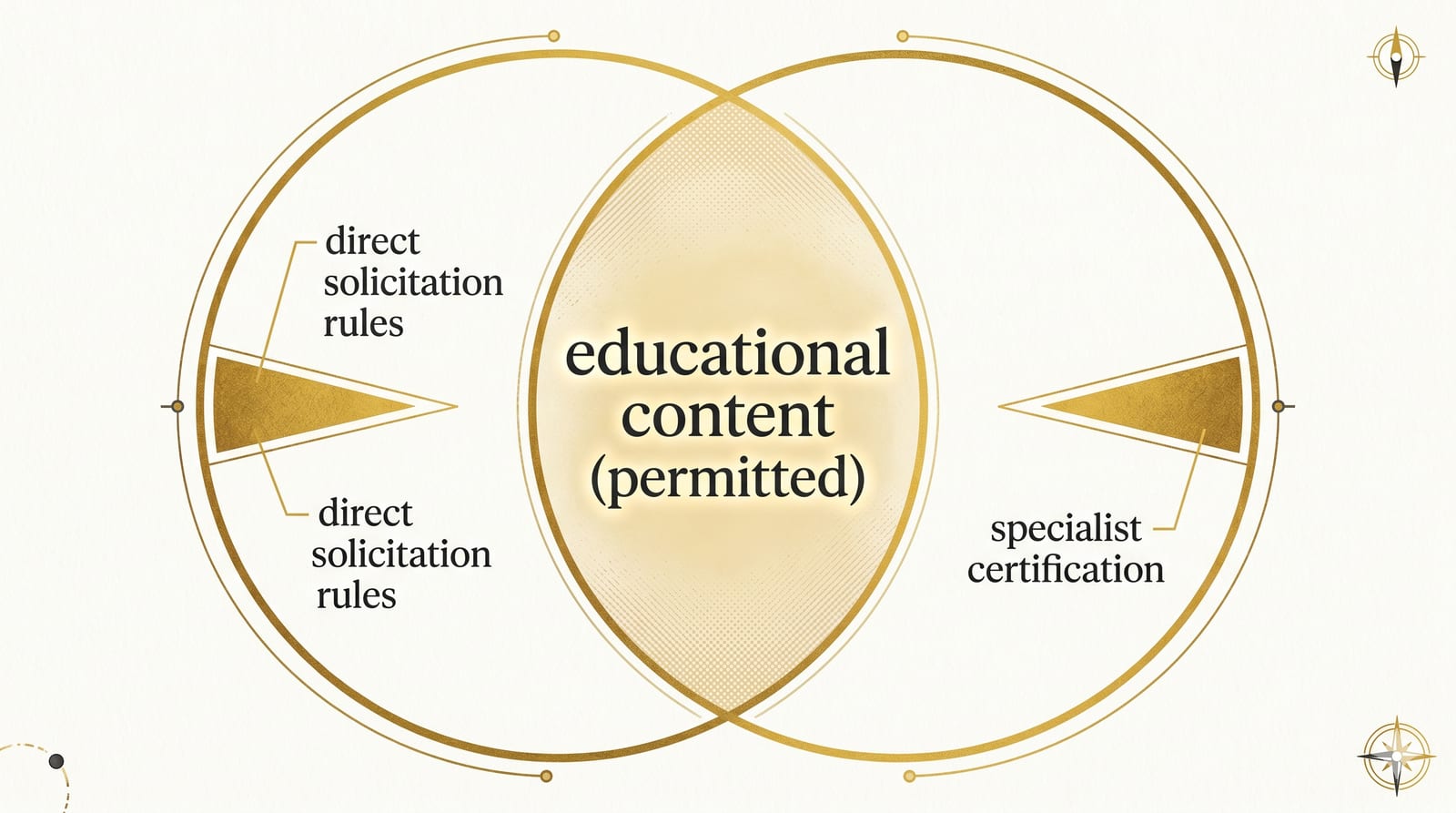
The compliance bar and the AI-citation bar diverge in only two areas, direct solicitation rules and specialist-certification language, neither of which applies to the educational content boutique firms should focus on first.
Honesty about the limits strengthens the argument. The two specifications are not identical at every edge.
First, direct-solicitation rules. ABA 7.3, SRA 8.9, the AU ASCR equivalent, and CPRA all prohibit certain forms of direct solicitation of strangers. AI citation has nothing to do with this; AI engines cite content that exists publicly, they do not solicit. So this divergence is moot for the educational content shape the playbook targets.
Second, specialist-certification language. Most jurisdictions prohibit claiming to be a “specialist” without formal accreditation. AI engines do not care about these labels; they reward specificity (“12 years handling international tax controversy matters”), not regulated superlatives. The constraint and the AI-citation criteria converge again, by removing a non-load-bearing label entirely.
Outside these two narrow areas, the bar and the algorithm want the same content.
What the Senior-Partner Warning Misses
The cost of the do-nothing default is not zero; it is the AI-citation share boutique competitors who read the rules carefully are taking right now while their compliance-cautious peers stay frozen.
A managing partner at a 14-attorney Manila boutique handling international tax controversy work tells her marketing manager to pause every content initiative. A senior peer at a larger firm had warned her over coffee that the new CPRA “basically bans marketing for lawyers.” The marketing manager, three months into building an editorial calendar with a Cebu-based contributor, freezes. Two months pass. The blog shows three posts published, all signed by the firm collectively rather than by named attorneys, all generic. Inquiry volume drops.
Late one Friday the marketing manager opens the actual CPRA text. Section 17 specifies: dignified, verifiable, factual. She reads it three times. She then opens the frozen draft pipeline. The drafts are: explainer articles on Philippine transfer pricing audits, a comparison of BIR procedural changes, a named-partner Q&A on revenue district office practice. Every single draft is dignified, verifiable, and factual. The freeze was not protecting the firm from a CPRA violation; it was protecting the firm from publishing the exact content CPRA explicitly permits.
She brings the verbatim Section 17 text to the managing partner. The managing partner reads it, calls her ethics counsel for a 30-minute review, approves the entire pipeline by Monday morning. The named-attorney drafts ship over the next six weeks. Three months later, two of the firm’s named attorneys are cited by name in a Perplexity answer to “international tax controversy boutique Philippines.” The senior peer who had warned about CPRA is not.
The story generalises. Replace CPRA with ABA Rule 7.1, with SRA Paragraph 8.9, with AU ASCR Rule 36. The freeze pattern is the same. The result of reading the actual text is the same.
The Practical Playbook for a Boutique Firm Starting Tomorrow
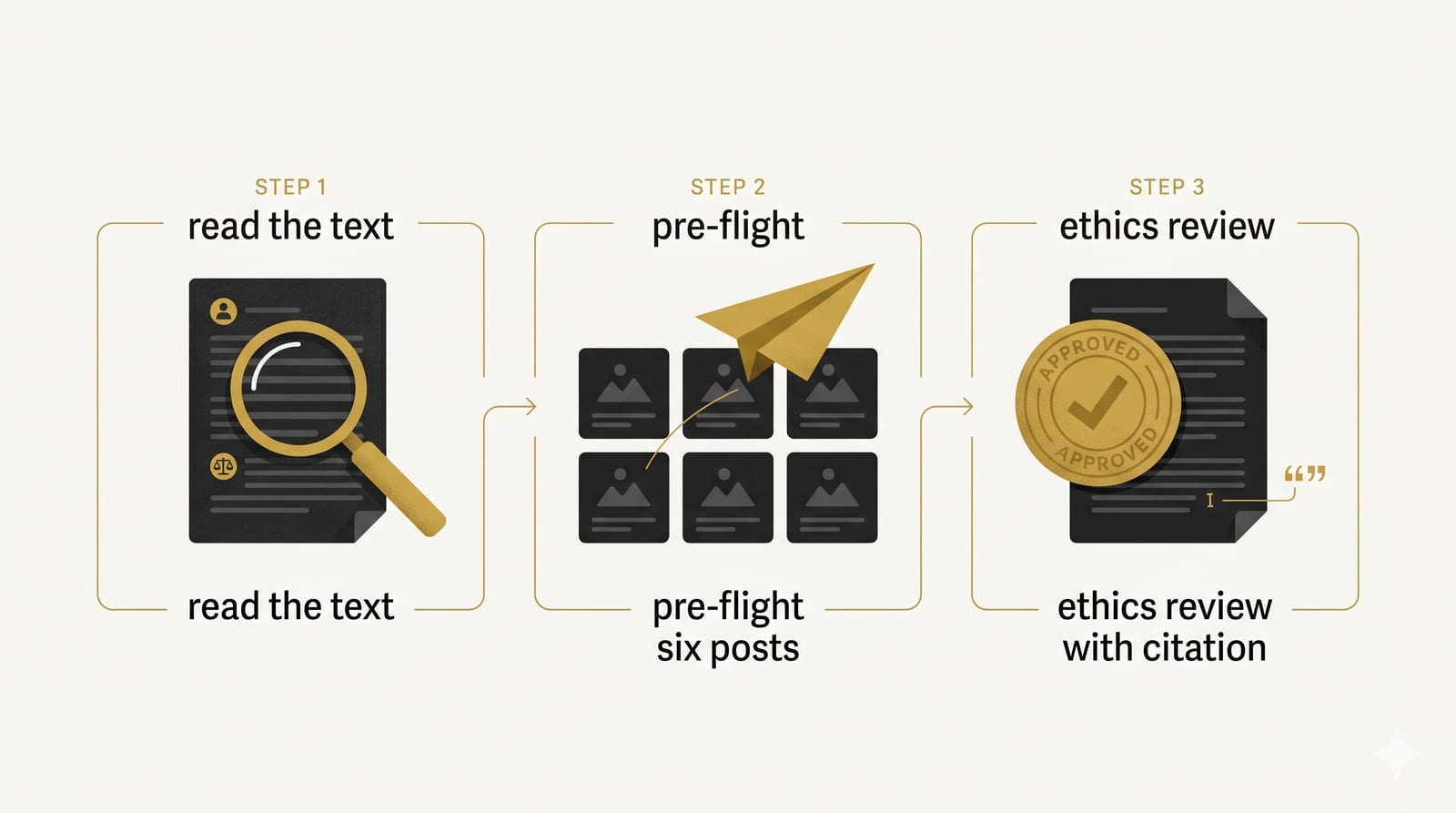
A boutique firm can start a compliant, AI-citation-optimised content engine in three concrete steps: read the local regulatory text, pre-flight a six-post pipeline against it, and route every draft through existing ethics review with the citation attached.
Step 1, Read the local regulatory text (90 minutes)
Reading the verbatim regulatory text takes 90 minutes and eliminates 80 percent of compliance ambiguity by surfacing what the rules actually say versus what the senior-partner warning implied.
Open the operative rule for the firm’s jurisdiction (CPRA Section 17 for PH; ABA Rule 7.1 to 7.3 plus the state bar’s overlay for US; SRA Paragraph 8.9 for England and Wales; ASCR Rule 36 for AU). Read it three times. Highlight the verbs of permission and prohibition. Most partners discover the rule is shorter and more permissive than working memory suggested.
Step 2, Pre-flight a six-post content pipeline against the text
A pre-flight content pipeline audited against the specific regulatory text turns abstract compliance review into a yes-or-no decision per draft.
Draft six topics the firm could legitimately publish: practice-area explainers, regulatory updates, named-partner Q&As, anonymised case studies, benchmarking analyses, methodology pieces. For each, cite the specific regulatory clause that authorises it. The pre-flight format turns abstract “is this allowed” into specific “this is allowed under [clause], because [reason].” Ethics review becomes a fast yes-or-no rather than a deliberation from scratch.
Step 3, Route every draft through existing ethics review with the citation attached
Routing each draft past ethics counsel with the specific regulatory clause cited inline shortens review from days to hours and rebuilds the marketing-compliance relationship from adversarial to collaborative.
The firm’s compliance officer reviews each draft with the cited clause attached. Most ethics counsel, presented with a dignified educational draft and the specific CPRA or ABA clause authorising it, approve faster than the marketing team expects. Compliance is no longer the bottleneck blocking marketing; compliance becomes the gatekeeper validating that marketing is reading the rules correctly.
Where This Goes Wrong (The Honest Edges)
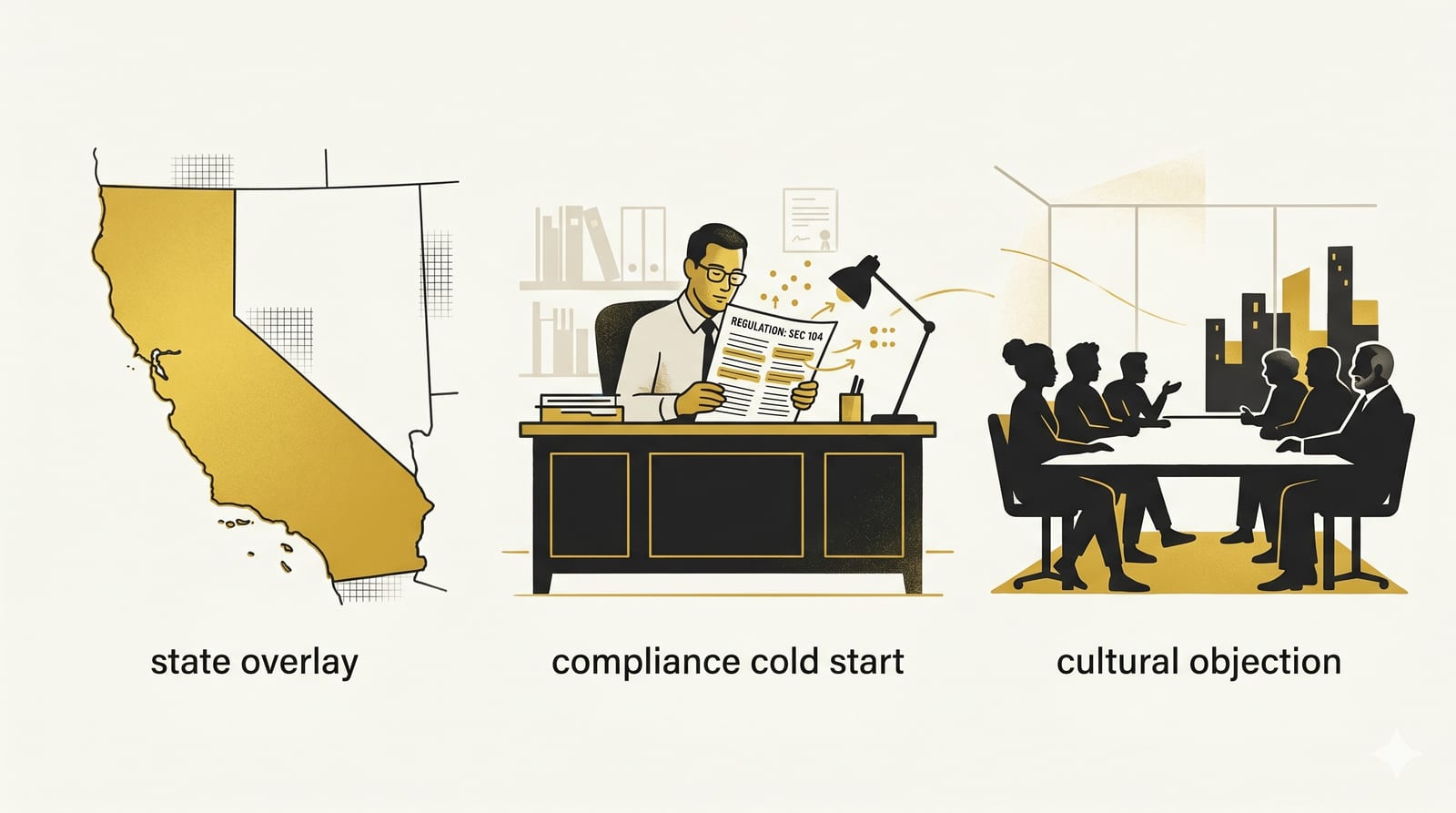
This reframe fails in three specific situations: a state bar with explicit overlay restrictions beyond the model rules, a firm whose compliance officer has not read the source citations, and a partnership whose objection to marketing is cultural rather than regulatory.
The reframe is robust but not universal. Three failure modes deserve honest treatment.
State or regional overlay. Florida, New York, and California (post-SB 37) apply ABA Model Rules with significant local additions. Some Philippine IBP chapters apply CPRA more strictly than the text suggests. Reading the model rule alone is not enough; the state-specific overlay must be read alongside, and the stricter standard applied.
Compliance-officer cold start. If the firm’s compliance officer has not read the relevant source citations themselves, they will default to “no” out of caution. Share the source citations directly with the compliance officer before submitting the first draft.
Cultural objection. Some partnerships object to marketing on dignity or generational grounds, not regulatory ones. The objection is that the firm has always grown through referrals and marketing is undignified regardless of what the rules say. This post does not address that objection; it is not a regulatory question and cannot be answered with a regulatory reframe.
What Happens to the Firms That Read the Rules Carefully
Boutique firms that read the rules carefully and ship compliant content engines now will own the AI-citation share-of-voice in their practice areas for the next decade because AI engines reward early citation density.
AI citation patterns compound. Firms that establish a citation footprint in 2026 develop a moat that competitors entering in 2028 or 2029 will struggle to overcome. AI engines weight citation density and consistency; firms with two years of published, cited content read as the authoritative source.
This is the structural advantage available to boutique firms right now. Big firms move slowly through internal compliance bottlenecks and partnership politics. Boutique firms, with one managing partner who can decide and one compliance officer who can review, can ship a compliant content engine inside a quarter. The firms that do this in 2026 own their practice areas in AI for a decade. The firms that stay frozen pass the citation share to firms that read the rules carefully and acted.
The senior peer who said “we can’t market” is reading a rule from memory, not from the page. Read the page. The page authorises the playbook your competitors are already running.
Frequently Asked Questions
Can lawyers advertise under bar rules in 2026?
Yes, in every major common-law jurisdiction (US, UK, AU) and in the Philippines (CPRA Section 17, 2023). The rules specify what kind of advertising is permitted (dignified, factual, non-misleading) rather than prohibiting advertising as such. Direct-solicitation rules and specialist-certification language vary, but baseline educational content is permitted everywhere reviewed here.
What is California SB 37 and how does it change lawyer advertising in 2026?
California SB 37, effective January 1, 2026, requires every law-firm website, landing page, paid search ad, and paid social ad to disclose office location and the name of the responsible attorney. Penalties range from $5,000 to $100,000 per violation, with a 72-hour takedown window. The law tightens transparency; it does not ban advertising.
What does PH CPRA Section 17 actually say about lawyer marketing?
PH CPRA Section 17 (A.M. No. 22-09-01-SC, April 2023) permits lawyers to advertise on any platform with dignified, verifiable, and factual information: biographical data, contact details, fields of practice, services offered. The rule prohibits self-laudatory content and paid endorsements to award-giving bodies or media personalities in exchange for publicity.
Are blog posts and educational content considered “advertising” under bar rules?
Generally yes. Every bar rule treats public-facing content from a law firm as communication concerning the lawyer’s services. This is good news: the same rules that permit advertising (truthful, non-misleading, with contact information) also permit educational blog content. Modern bar rules care about content character (dignified, accurate, not deceptive), not content format.
Can I call myself a “specialist” or “expert” in my marketing?
Only if you are formally certified by a recognised body. ABA Rule 7.4 prohibits the “specialist” claim without certification; AU ASCR Rule 36 specifically prohibits the “accredited specialist” label without authorisation. The workaround is to describe practice depth concretely (for example, “12 years handling international tax controversy matters”) rather than via a regulated label.
Does AI search optimisation conflict with bar advertising rules?
No. AI search engines reward content with a named-author byline, verifiable credentials, factual claims with inline citations, structured data, no exaggerated guarantees, and a third-party verification path. Every one of these is explicitly permitted (or required) by ABA Rule 7.1, PH CPRA Section 17, SRA accuracy requirements, and AU ASCR Rule 36. Compliance specification and AI-citation criteria converge on the same content shape.
What kind of content can I publish without compliance review?
None. Every piece of public-facing content from a law firm should pass internal compliance review before publication. The reframe in this post is that compliance review goes from days to hours when each draft cites the specific regulatory clause it complies with. Pre-flighting the pipeline makes review fast, not optional.
Do I need to worry about social media posts the same way as blog posts?
Yes. Bar rules apply to communications regardless of format. Social media adds two specific risks beyond blog content: unsolicited direct messages (prohibited as direct solicitation under ABA Rule 7.3, SRA Paragraph 8.9, and equivalents) and engagement-bait language that could read as creating unjustified expectations under ABA Rule 7.1. The fix is the same content character on social as on the blog: educational, factual, dignified, no direct messages to strangers.
What happens if my state bar reads the rules more strictly than ABA does?
State-specific overlay is real and binding. Florida, New York, and California (post-SB 37) are the most common jurisdictions where state rules exceed the model rules. Read both the model rule and the state variation, apply the stricter standard, and have a state-licensed ethics counsel approve the content plan. The cross-jurisdictional reframe is a starting point, not a substitute for state review.
How quickly can a boutique firm see citation results from a compliant content engine?
AI Overview citation patterns typically begin shifting within 6 to 12 weeks of consistent publication, with measurable share-of-voice gains in 3 to 6 months for boutique firms targeting specific practice-area queries. The pace depends on publication consistency (weekly is the floor), named-attorney byline presence, and third-party citation surface participation (LinkedIn longform, Reddit, podcast appearances).
Author page: Mark Buraga, Independent SEO Consultant, Growth Engine PH: /mark-buraga/
Internal links: How AI Overviews route around boutique law firms | Schema Markup for AI Search Visibility | Let’s Talk
Ready to put this into practice? See our SEO services.