By Mark Buraga, Independent SEO Consultant at Growth Engine PH
Last updated: 8 October 2026
Ask Google AI Mode for the best GEO consultants and most of the sources behind the answer are listicles, not the consultants. Over seven weeks of tracking, listicles supplied 70% of the cited pages on that question. Six of the eleven listicles cited most often were published by a firm that listed itself in the ranking, and at least four put themselves first.
That is the market behind every “best agency” question a buyer asks an AI engine. The provider being chosen rarely writes the source. Someone with a list does, and often that someone is a competitor.
This post is the data behind that claim, where it breaks down, and what a firm can actually do about it.
Why do listicles win AI answers to “best agency” questions?
Listicles win “best” and “top” questions because those questions ask for a comparison, and a listicle is the only page type that already contains one: several named providers, ranked, on a single page an engine can quote.
A provider’s service page answers a different question. It says what one firm does. It cannot say which firm is best, because no buyer would believe it. A list can, and the engine treats it as the closest thing to a neutral answer.
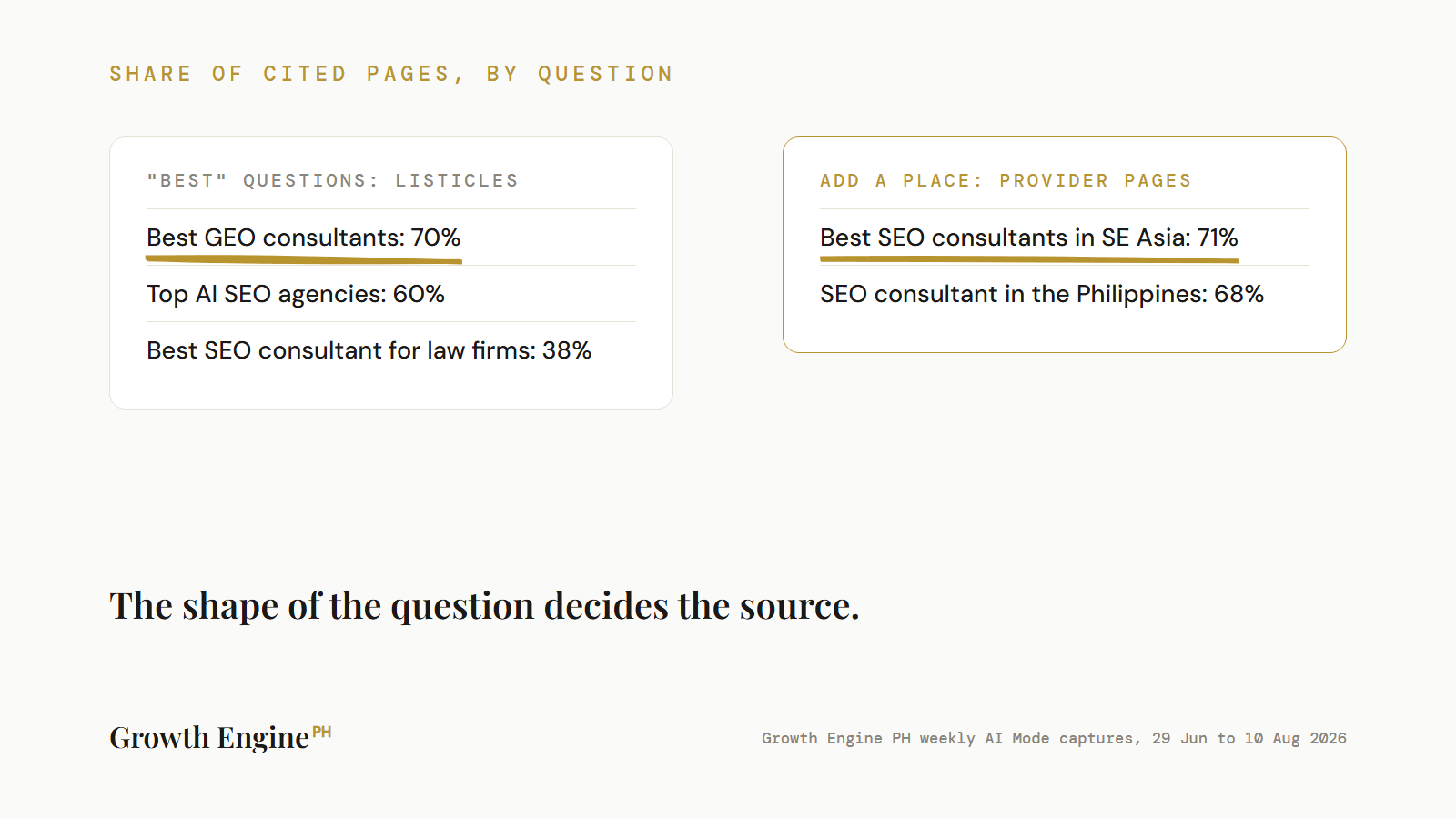
Our own captures show how strongly the shape of the question decides the source. Across 1,007 cited pages on ten buying questions, the split by question was:
| Question | Listicles | Provider pages |
|---|---|---|
| Who are the best GEO (generative engine optimization) consultants? | 70% | 14% |
| Top AI SEO agencies for professional services firms | 60% | 18% |
| Growth Engine PH alternatives | 41% (+27% directories) | 24% |
| Best SEO consultant for law firms | 38% | 28% |
| SEO consultant in the Philippines for international clients | 18% | 68% |
| Best SEO consultants in Southeast Asia | 18% | 71% |
The last two rows are the interesting ones. “Best SEO consultants in Southeast Asia” is still a “best” question. Adding a place flipped it: provider pages took 71% of the citations. A narrow question has fewer lists written for it, so the engine falls back to providers who built a page for exactly that question.
How we measured it
Every week we run the same 15 questions through Google AI Mode from a Philippines session and record every cited source. Ten of the 15 are buying questions: five about services, five comparing providers. The full procedure, prompt set and capture conditions are in our method.
For this post we used two cuts of that data:
- Domain counts: eight weekly captures, 13 June to 10 August 2026. The ten buying questions returned 1,016 domain appearances from 568 distinct domains. 405 of those domains appeared once and never again. Reddit led with 34 appearances, as covered in most-cited domains.
- Page types: seven captures, 29 June to 10 August, because the first capture stored domains but not page URLs. That gave 1,007 cited-page appearances, which we sorted by page type from the URL: listicle, provider page, article, community post or directory.
The URL sort is a rule, not a reading of every page. We spot-checked it and removed the one false positive we found from the listicle list below.
Who writes the listicles that AI search cites?
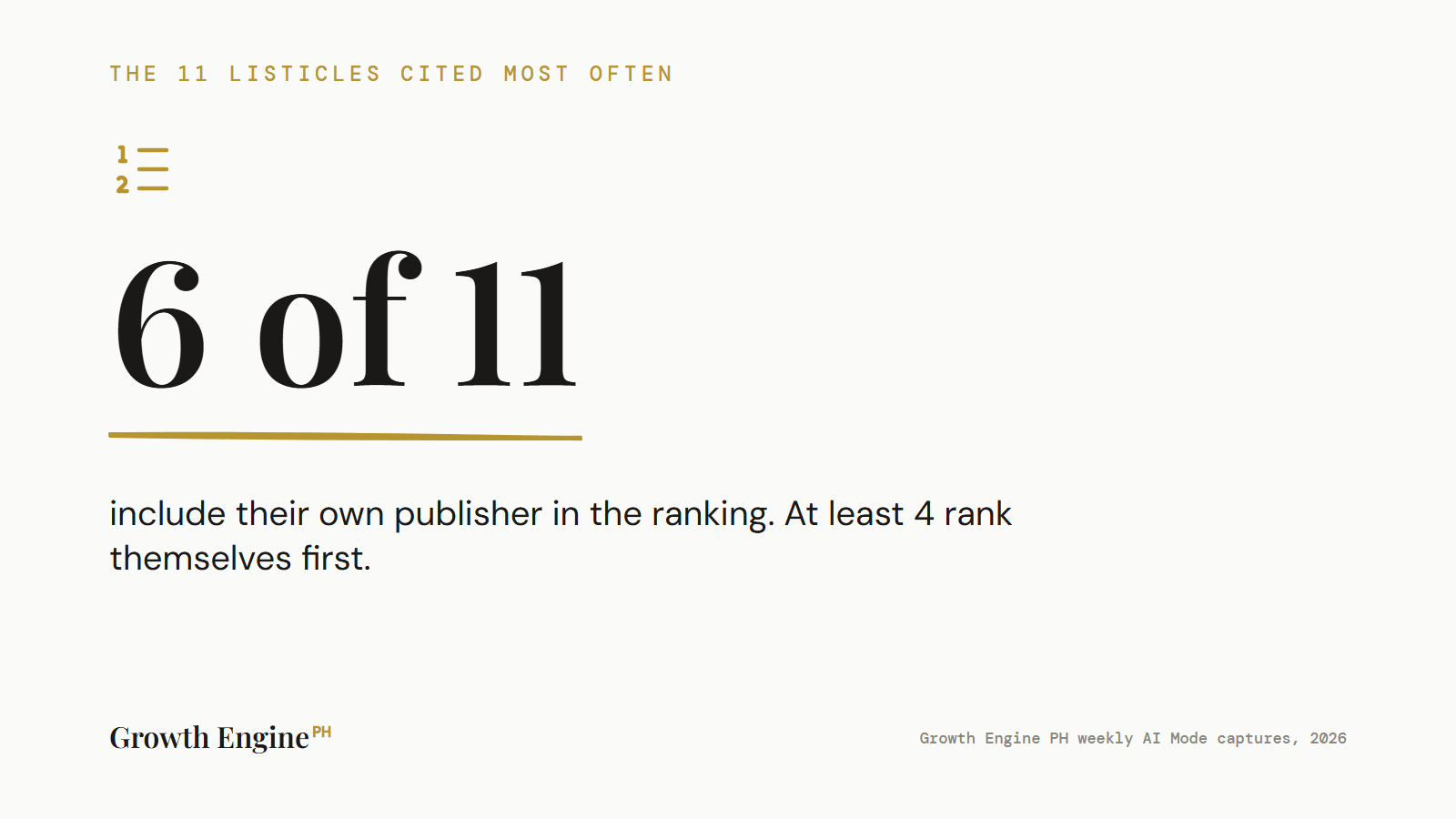
Often the same firms the lists rank. Of the 11 listicles cited four or more times, six include their own publisher in the ranking, and at least four put themselves in first place.
We fetched each of the 11 pages and checked their ranked headings for the publisher’s own name. Pages where the name appears only as an author byline were not counted. Neither were pages where we could not find a self-listing.
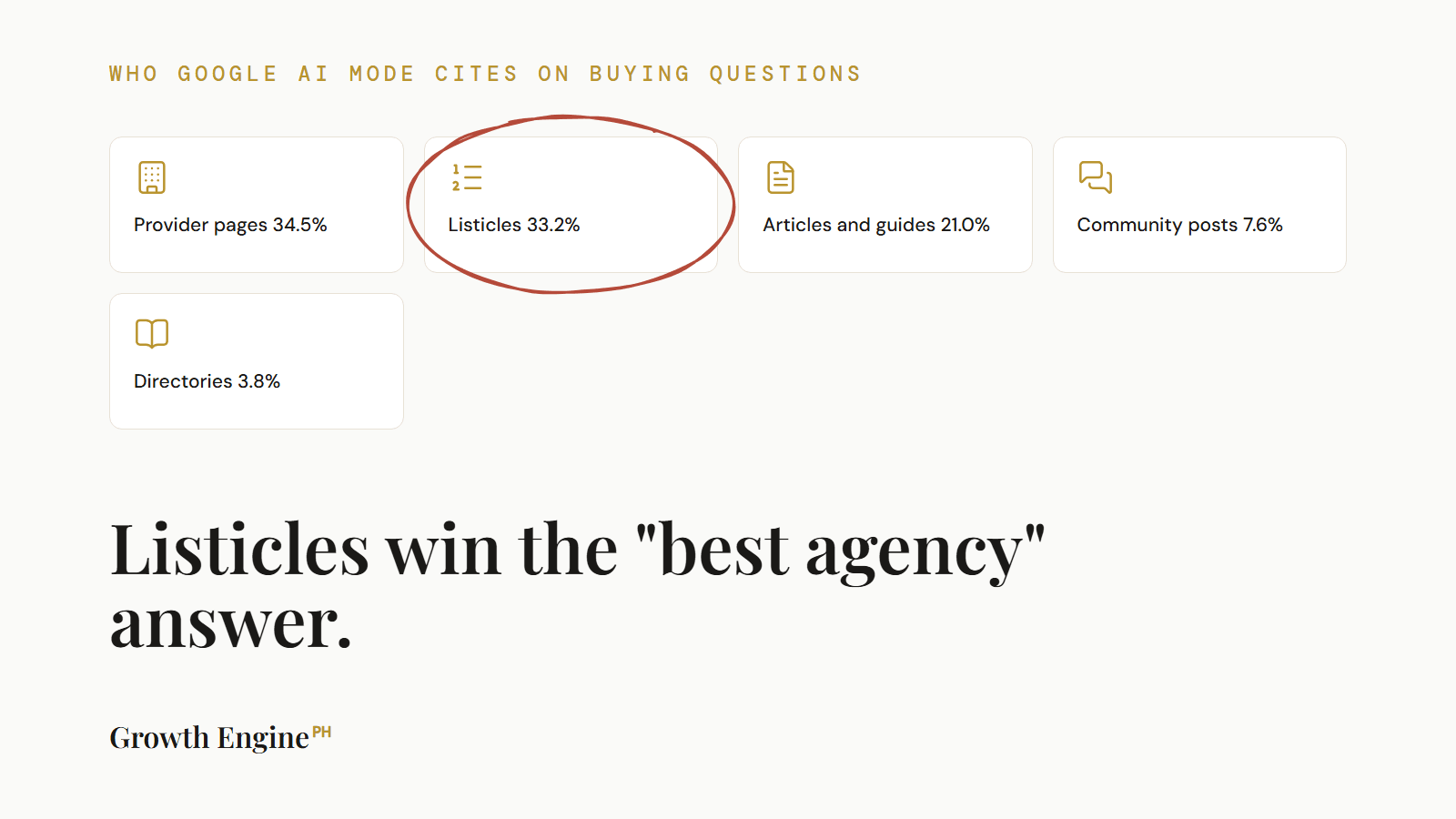
| Overall page types across 1,007 cited pages | Share |
|---|---|
| Provider pages (homepages and service pages) | 34.5% |
| Listicles and “best of” lists | 33.2% |
| Articles and guides | 21.0% |
| Community posts (Reddit, LinkedIn, Medium) | 7.6% |
| Directories and review platforms | 3.8% |
None of this breaks a rule. A firm is free to publish a list and include itself, and many of these lists are well researched. But a buyer reading an AI answer sees a recommendation, not the commercial interest underneath it. The engine passes the list’s conclusion through without the context of who wrote it.
For a firm trying to be recommended, the lesson is blunt. On “best” questions you are competing with the people who write the lists, and some of them are your competitors.
When does a provider’s own page win instead?
A provider’s page wins when the question is narrow enough that nobody has written a list for it, and the page is named for exactly that question.
The pages cited most consistently across our seven weeks were not generic homepages. They were pages built for one specific question:
- A “best AI SEO agencies” listicle, cited all 7 weeks on the question “Top AI SEO agencies for professional services firms”.
- A Philippines SEO service page, cited 6 of 7 weeks on “SEO consultant in the Philippines for international clients”.
- Pages built for accounting firms, including a “GEO agency for accountants” page and a GEO-for-accountants guide, cited 5 to 6 weeks on “GEO services for accounting firms”.
- A law firm SEO service page, cited 5 of 7 weeks on “How much should a small law firm pay for SEO?”.
The pattern holds across all of them. The page title and the buyer’s question were close to the same sentence. A firm that serves accountants and has one general services page will lose that question to a firm with a page that says “for accountants” in its heading.
This is the same retrievability logic behind citation architecture: an engine cites the page whose answer lifts out cleanly for the question asked.
Why does nobody hold a citation for long?
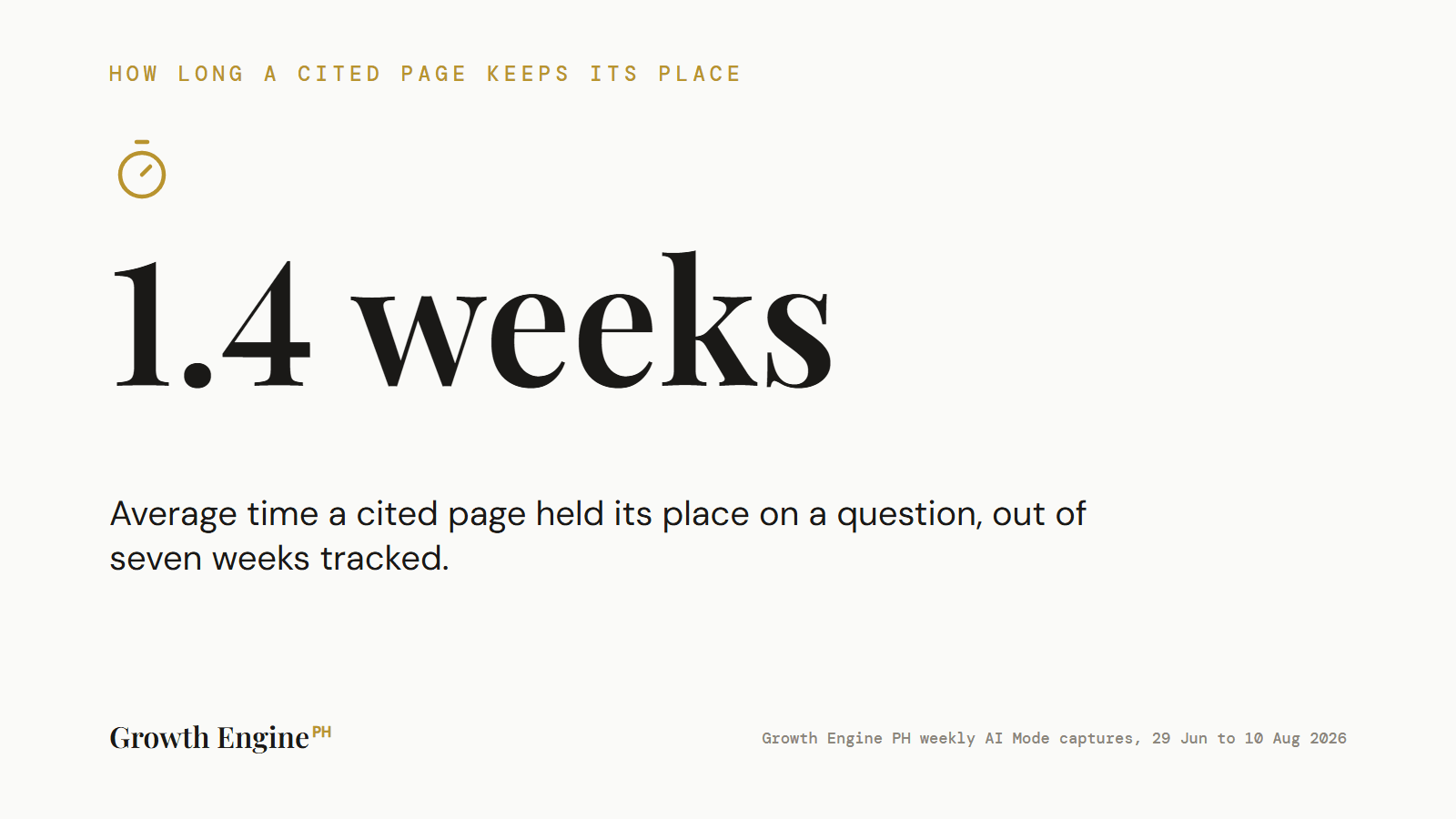
Because the answer is rebuilt every time, and on our data no page type holds its place. A cited page stayed on the same question for 1.4 weeks on average out of seven, and only 4% to 10% of page and question pairs were cited in four or more weeks.
| Page type | Average weeks cited on a question (of 7) |
|---|---|
| Articles and guides | 1.26 |
| Provider pages | 1.32 |
| Listicles | 1.41 |
| Community posts | 1.54 |
| Directories | 1.58 |
Listicles win more often, but they do not win permanently. That matters for two reasons.
First, a single snapshot of who an AI engine cites tells you very little. The same set of questions returned anywhere from 57 to 243 sources a week on our own site, which we measured in our volatility post.
Second, being on one list is not enough. The engine draws from a wide, shifting pool, so a firm needs to appear in several credible places, not one.
Should you pay to get into listicles?
Usually not, and never without disclosure. Some roundups sell placements, and a paid spot on a list that presents itself as independent is the kind of undisclosed endorsement buyers and regulators both object to.
The honest version of this work is a PR motion, not an on-page one:
- Find the lists that already get cited for your questions. Run your buyers’ questions through the AI engines they use and note which roundups appear.
- Earn a place on the credible ones. Editorial lists include firms with visible proof: named clients, published results, real reviews. Make that proof easy to verify.
- Ask how a list is compiled before you engage. If inclusion is paid, the list should say so. If it does not, walk away.
Getting named on lists also feeds the other half of AI visibility. A citation is a link to your page. A mention is your name inside the answer, and that comes from other people writing about you, which is the subject of mention mechanics.
What to do instead of chasing “best agency” queries
Split the work by question shape, because the two shapes reward different things.
For “best” and “top” questions: you will rarely win with your own page. Aim to be named on the credible lists the engine already uses, and measure whether you are mentioned in the answer, not just linked.
For narrow questions: build the page. One page per service and audience combination your buyers actually search, named in their words: the service, the audience, the place. Answer the question in the first paragraph. These are the pages that held citations week after week in our data.
For both: track it weekly, as a range, on a fixed question set. A single month’s screenshot will tell you whatever that week happened to say.
Where this data stops
This is one engine (Google AI Mode), one location (a Philippines session) and ten questions in our own market, captured weekly from June to August 2026. It describes how AI Mode answered these questions over those weeks. It does not describe ChatGPT, Perplexity or any other market.
Since 31 August, Google routes AI Mode citation links through a redirect that hides the destination, so this page-level analysis cannot currently be repeated on new captures. We explained that change in goto redirect.
The page-type sort is rule-based and spot-checked, not hand-read across all 1,007 pages. Treat the shares as close, not exact.
Frequently Asked Questions
What are listicles?
Listicles are articles built as a numbered or ranked list, such as “10 best GEO agencies”. In AI search they matter because a list already compares several providers on one page, which is exactly what a “best” question asks for. On our data, listicles supplied 60% to 70% of the cited pages on the two broadest “best” and “top” provider questions.
Why does AI search recommend my competitors instead of me?
Often because your competitors appear on the listicles the engine cites, and sometimes because they wrote those lists. On “best” questions the engine leans on lists. On narrow questions it leans on provider pages built for that exact question. Check which of the two shapes your buyers’ questions take.
How do I get my business into AI answers for “best” questions?
Earn a place on the credible roundups that already get cited for your questions, and make your proof easy to verify: named clients, published results and real reviews. Avoid paid placements on lists that do not disclose them.
Do I need a separate page for every service?
For the services and audiences your buyers search for specifically, yes. The pages that held citations longest in our data were named for one question, such as an SEO page for one country or a GEO page for accountants. A single general services page lost those questions to more specific pages.
How long does an AI citation last?
On our data, not long. A page cited for a question stayed for 1.4 weeks on average out of seven, and only 4% to 10% of pages were cited in four or more weeks. Measure citations weekly as a range rather than trusting one snapshot.
Are best-of lists in AI answers trustworthy?
Treat them as a starting point. Of the 11 listicles cited most often in our data, six included their own publisher in the ranking and at least four ranked themselves first. Check who wrote a list before you rely on its order.