By Mark Buraga, Independent SEO Consultant at Growth Engine PH Last updated: 11 June 2026
Here is a number that should reset how you think about AI search. Only 38 percent of the pages cited in Google AI Overviews also rank in the top 10 organic results, down from 76 percent eight months earlier (Ahrefs). Ranking and being cited used to move together. They are coming apart.
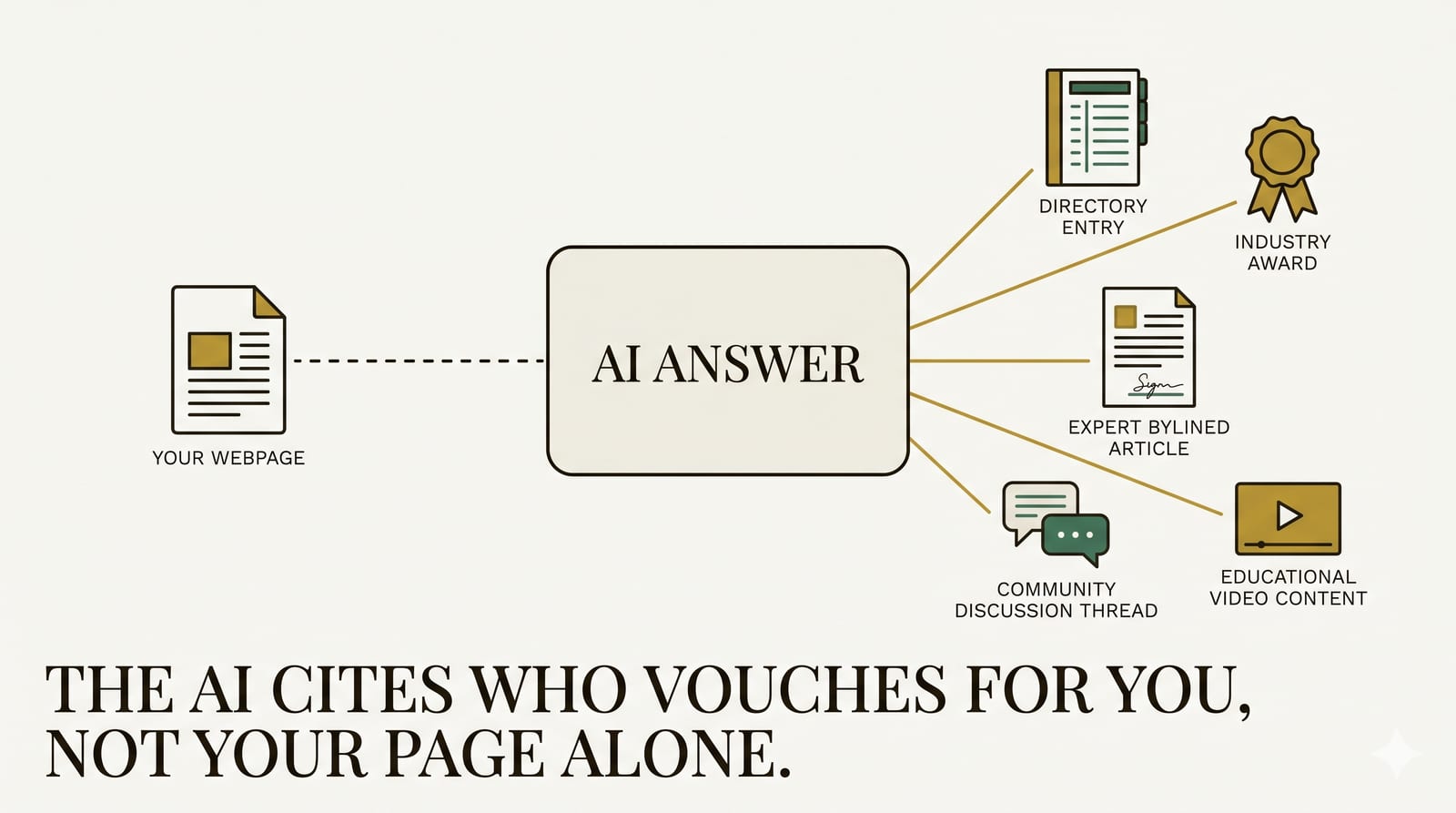
That gap is the whole story of this post. AI engines do not decide who to cite by reading your website. They decide by reading what credible third parties say about you across a small number of surfaces they preferentially trust. Most generative engine optimization work optimizes the wrong layer: schema, on-page copy, FAQ markup. That work is the foundation, not the finish line. The layer that actually decides whether you appear in an AI answer is mostly off your site. Build the right surface, and the citations follow.
The Premise Most GEO Advice Gets Wrong
AI engines do not decide who to cite by reading your website. They decide by reading what credible third parties say about you across a small set of surfaces they trust.
Open any “how to get cited by AI” guide and the advice is nearly always the same: publish helpful content, add structured data, build authority on your pages. All true, all necessary, and all incomplete. It treats AI citation as an on-page job, the same way classic SEO treated ranking as an on-page job.
The decoupling stat is the tell. When 76 percent of AI-cited pages also ranked top 10, you could believe citation was just ranking by another name. At 38 percent, that belief breaks. A page can rank first and go uncited, and a page that does not rank at all can be cited, because the engine is weighting signals that live somewhere other than the page.
What it weights is third-party validation. An AI engine answering a question is not running a popularity contest; it is assembling a defensible answer and deciding which sources are safe to name. To do that it cross-checks your own claims against what independent sources say about you. Your site says you are a leading provider of X. The engine wants to know who else says so, and whether those someones are credible. If the answer is “no one it trusts,” you do not get cited, no matter how clean your markup is. This is the same reason the acronyms AEO and GEO describe different surfaces: the optimization target moved off the page, and the vocabulary is still catching up.
What AI Engines Actually Read From (The Five-Layer Citation Surface)
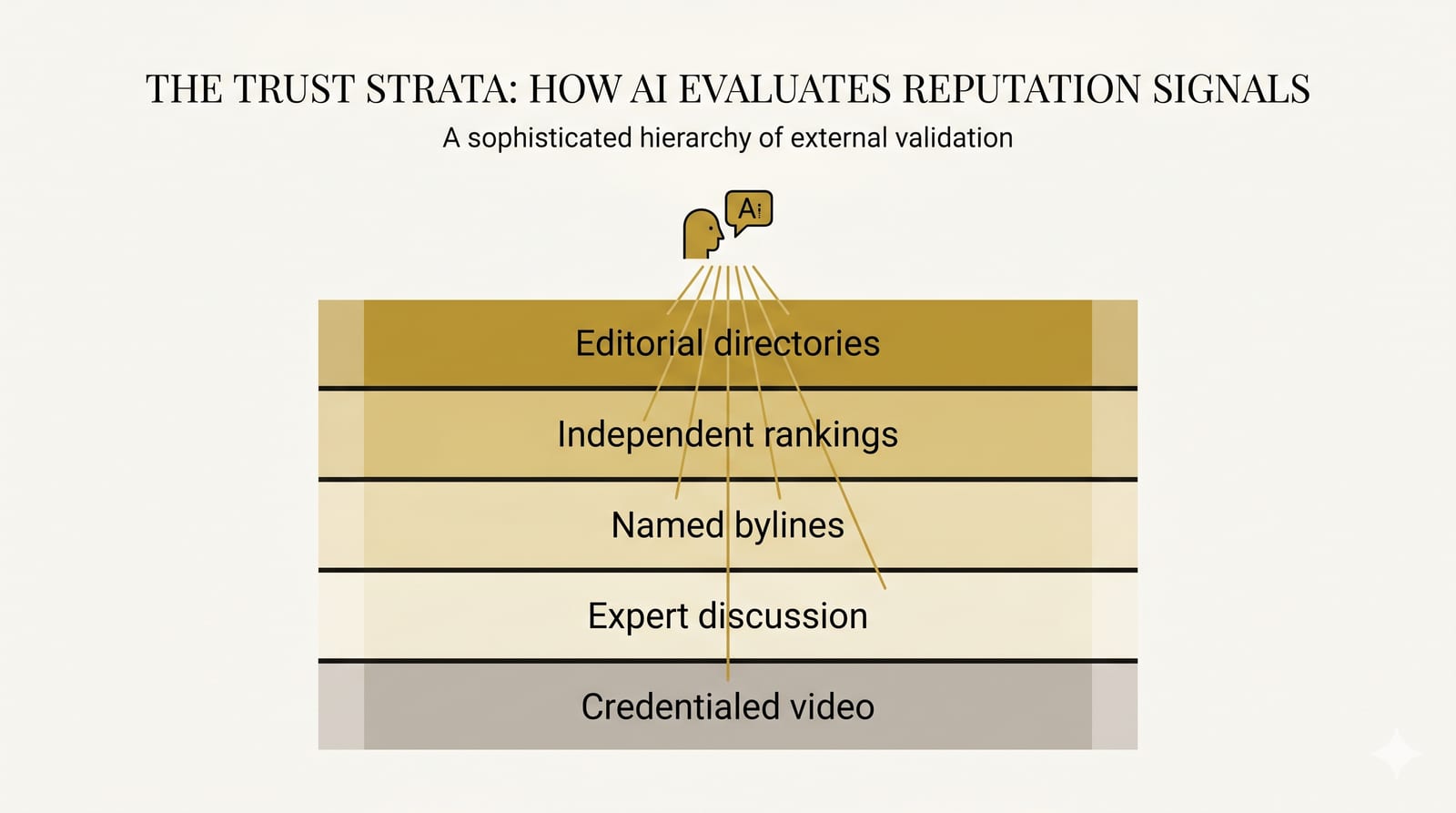
AI engines preferentially read from five layers of third-party validation: editorially-overseen directories, independent industry rankings, named-byline publications, expert discussion platforms, and credentialed video transcripts.
Not all of the open web counts equally. AI engines lean on a short list of surfaces that act as credentialing layers. Here are the five that matter most, in roughly the order they carry weight.
Layer 1: Directories with editorial oversight
The engine trusts a directory that has human editorial review or verification far more than one that publishes any paid listing. An industry register, a vetted marketplace, a curated “who’s who” with a real methodology: these are reference points the engine treats as closer to fact. A pay-to-list directory is close to noise. Check which kind you are in, and whether your entry is current.
Layer 2: Independent industry rankings
Recognition you earned rather than bought is a strong citation signal. Awards, analyst rankings, and “best of” lists that publish their criteria function as peer-reviewed credibility. The engine reads them as a third party vouching for you on the record. This is the layer most sites never deliberately pursue.
Layer 3: Named-byline industry publications
A named expert with a byline in a recognized publication carries more citation weight than the same person publishing the same idea anonymously on a company blog. The byline is an authorship and accountability signal, and AI engines increasingly resolve content to the person behind it, not just the domain. One earned byline can outperform a dozen ghostwritten posts.
Layer 4: Expert discussion platforms
Reddit, Quora, and Stack Exchange are where practitioners answer practitioners, and AI engines read them heavily as concentrated-expertise surfaces. Ahrefs Brand Radar has repeatedly found Reddit among the most-cited domains across major AI engines. You do not need a marketing presence there. A credible person answering real questions under a real name, a few times a quarter, changes what the engine finds when it checks who vouches for you.
Layer 5: Credentialed video transcripts
AI engines read YouTube transcripts, and explainer videos from named, credentialed creators surface in AI answers at a rate well beyond their view counts. The transcript is the citation surface, not the view. A short, specific video on a narrow topic can get pulled into an answer long after it is posted, which makes video one of the most underpriced layers available.
Why Schema Markup Is the Pointer, Not the Citation
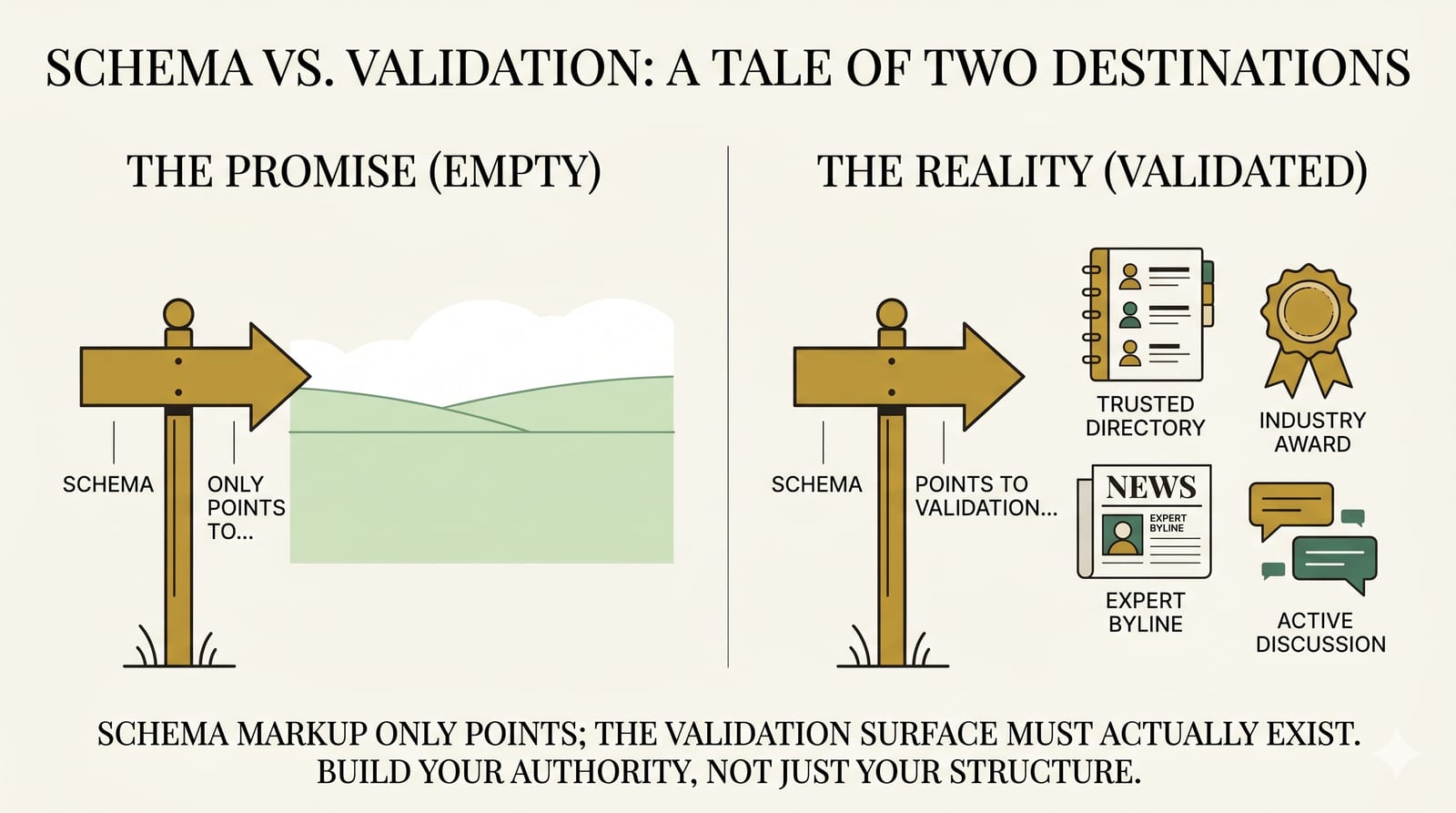
Schema markup tells AI engines where to look for third-party validation. It does not create the validation. If the surface it points at is empty, there is nothing to find.
This is where most GEO retainers quietly fall short. Schema, and sameAs linking in particular, tells an engine that your on-page identity claims to match a set of off-page profiles. That is genuinely useful: it helps the engine connect your site to your directory entry, your ranking, your social profiles. But it only points. It does nothing to make the thing it points at any stronger.
If your directory entry is thin, your independent rankings are nonexistent, and you have no named-byline coverage, then sameAs is a tidy signpost aimed at an empty lot. The engine follows the pointer, finds weak validation, and moves on. The schema work is necessary and emphatically not sufficient. The off-page surface has to actually exist and be credible before pointing at it produces anything. Structured data is still the substrate that connects the two layers, which is exactly why it gets mistaken for the whole job.
How to Audit Your Citation Surface
A citation-surface audit checks your presence and accuracy across the five layers and returns a layer-by-layer gap list you can act on in an afternoon.
You can run a rough version of this yourself. Go layer by layer.
- Directories: List the editorially-overseen directories in your space. Are you in them? Is every detail current and consistent with your site, down to the name and category? Stale or conflicting entries are worse than none.
- Rankings: Have you earned any independent recognition with a published methodology in the last 18 months? If not, that is a gap, not a vanity item.
- Bylines: Count your named-author placements in recognized publications over the past year. Speaking slots and webinars that never became written, attributed content are missed conversions.
- Discussion: Search your topic on Reddit and Quora. Is anyone credible from your side present in the threads where your audience’s experts gather? Or is the conversation happening entirely without you?
- Video: Do you have credentialed explainer content that gets transcribed and indexed, or one unlisted internal clip?
Score each layer present-and-strong, present-but-weak, or absent. The pattern almost always shows the same thing: the on-page work is done and the off-page surface is empty. That is the gap to close, and you can confirm it the same way AI engines do, by watching how directory-style queries get routed to aggregators instead of to you.
What to Build (And What to Stop Paying For)
Stop paying for on-page-only GEO. Start investing in the off-page surface: directory accuracy, earned rankings, named bylines, and credentialed participation where your audience’s experts gather.
Once the audit shows the imbalance, the reallocation is obvious. Most of this does not need a bigger budget; it needs the budget pointed at a different layer. If a vendor is reporting schema implementation and FAQ markup as the GEO deliverable and nothing about directories, rankings, bylines, or discussion presence, they are doing the smaller half of the work and reporting it as the whole.
The questions to ask any current or prospective vendor are simple. Which third-party surfaces are in scope? How will we earn named-byline coverage? What is the plan for the directories and rankings AI engines actually read? If the answers are all on-page, the plan is half-built. The off-page surface is slower and harder to manufacture, which is precisely why it is worth more when it is real.
The Asymmetric Advantage for Smaller Players
The citation surface rewards consistency and depth more than budget, which is the rare layer where a small, focused brand can match a much larger competitor.
There is good news in this for anyone without an enterprise marketing budget. The third-party surface rewards operational consistency over spend. A small site with a perfectly consistent footprint will routinely surface above a large one whose details are scattered and contradictory across the web, because the engine can verify the small one with confidence and cannot verify the large one at all.
That is an unusual place to compete. You cannot outspend a category leader on paid media, but you can absolutely keep a cleaner, more consistent, more credentialed citation surface than they do, especially if they are big enough that no one owns the consistency problem internally. The work is operational, not capital-intensive: get the entries right, earn the recognition, publish under real names, show up where the experts are. Depth and consistency are buyable with attention, not just money.
Timeline and What to Expect
Expect first AI citations roughly 60 to 120 days out for ChatGPT and Perplexity, and 30 to 60 days for Google AI Overviews with fresh content signals.
This is not an overnight lever, and anyone promising instant AI citation is selling something. Once the off-page surface work is genuinely underway, expect ChatGPT and Perplexity to reflect it in about 60 to 120 days, and Google AI Overviews to move faster, roughly 30 to 60 days when paired with content freshness signals (LovedByAI).
Monitor it deliberately. Run your priority queries through ChatGPT, Perplexity, and Google AI Overviews on a monthly cadence and watch whether you start getting named. The signal you want is not a ranking change; it is your name appearing inside the answer, on queries where you were invisible before.
AI engines are not reading your website to decide who to cite. They are reading who vouches for you. The on-page work is necessary. The third-party citation surface is what actually decides. If you are not being cited, the next move is not “produce more content.” It is to audit who AI trusts to vouch for you, and go build that surface on purpose.
Engine Pro audits the third-party citation surface AI engines actually read from and rebuilds it layer by layer. If your AI visibility is not matching your rankings, let’s talk.
FAQs
How does ChatGPT decide which sources to cite? It cross-references your own site against a short list of third-party sources it trusts: editorially-overseen directories, independent industry rankings, named-byline publications, and expert discussion platforms. Your on-page signal is moderated by what those sources say about you. A thin or inconsistent third-party surface means no citation, even when your site ranks well.
Why isn’t my site cited by AI even though it ranks #1 on Google? Because ranking and citation have decoupled. Only 38 percent of AI Overview-cited pages also rank top 10, down from 76 percent eight months earlier. Strong ranking no longer predicts AI citation. The usual cause is a weak or fragmented third-party citation surface, plus identity signals the engine cannot confidently verify.
Is GEO different from traditional SEO? Yes. Traditional SEO optimizes for ranking and clicks on the results page. Generative engine optimization aims to get cited inside AI answers, which depends more on the off-page third-party surface than on-page work alone. See how AEO, GEO, and the other acronyms map to different surfaces for the full distinction.
How long does it take to get cited by AI? Once the off-page surface work is underway, expect about 60 to 120 days for ChatGPT and Perplexity, and 30 to 60 days for Google AI Overviews with content freshness signals. Anyone promising faster is overselling.
Do I need to be on Reddit and YouTube to get cited by AI? Not as a marketer, but a credible person from your side should be present where your audience’s experts gather. AI engines read Reddit, Quora, and YouTube transcripts heavily as concentrated-expertise surfaces. A real expert answering real questions under a real name, or recording short explainer videos, changes what the engine finds. It is credible participation, not influencer marketing.
How do I check if AI engines are citing me? Manually test your priority queries across ChatGPT, Perplexity, Gemini, and Google AI Overviews and note whether you are named. Tools including Ahrefs Brand Radar, SE Ranking’s AI Overview tracker, and Semrush’s AI Visibility toolkit automate citation share-of-voice against competitors.
Related reading: What is SERP optimization and the 6-Block GEO Diagnostic.