
By Mark Buraga, Independent SEO Consultant at Growth Engine PH
Last updated: 23 October 2026
Our own audit page ranked on page one of Google for three months. It earned zero clicks. Nothing on it was broken.
That page taught me what AI actually replaced in SEO, and what it did not. This post shows the data, both ways, and what to check before you pay for SEO.
Is SEO dead in 2026?
No. SEO is not dead, but AI answers now take clicks from searches that only wanted a quick answer, so the work has changed.
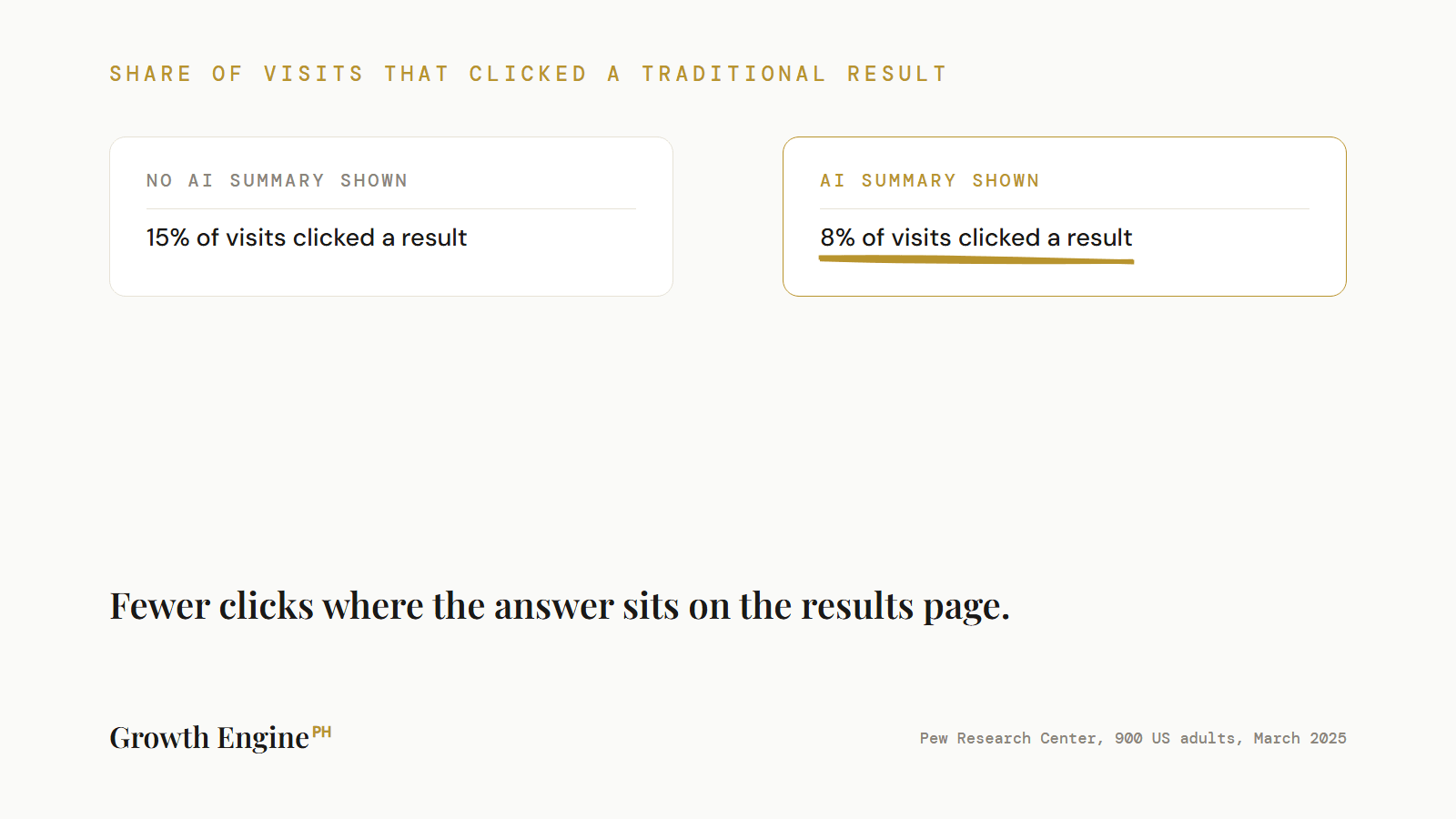
Start with the clicks. Pew Research Center followed the real browsing of 900 US adults in March 2025. People clicked a traditional search result in 8% of visits when Google showed an AI summary. Without one, they clicked in 15% of visits (Pew Research Center, July 2025). An AI summary is the short answer Google writes at the top of the results page.
Ahrefs saw the same drop in a bigger sample. It compared 300,000 keywords and found that the top result’s click-through rate was about 58% lower when an AI Overview showed (Ahrefs, February 2026). Click-through rate is the share of people who see a result and click it. Two cautions apply. The figure covers desktop only. And Ahrefs reports a correlation, partly modeled against a forecast, not a proven cause.
Now the other side. Google says there are “no additional requirements to appear in AI Overviews or AI Mode, nor other special optimizations necessary.” It also says “all existing SEO fundamentals continue to be worthwhile” (Google Search Central, December 2025).
Practitioners disagree, and both can be right. One operator in r/seogrowth reported organic traffic “down ~50%” across their products. Another, in r/AskMarketing, reported traffic down about 20% while leads and sales rose at least 10%, because the lost clicks came from “what is X?” pages that rarely converted. Both numbers are self-reported and unverified. The pattern is real, though: the loss depends on the kind of query.
People still ask the question. About 1,300 people a month in the US search for “is seo dead” (Ahrefs, October 2026). The better question is which part of SEO is dead.
What part of SEO is dead, and what did AI actually replace?
AI replaced the checklist: the generic answer, the first draft, the keyword list and the audit crawl are now fast or free.
Here is the clearest case I have. It is our own page.
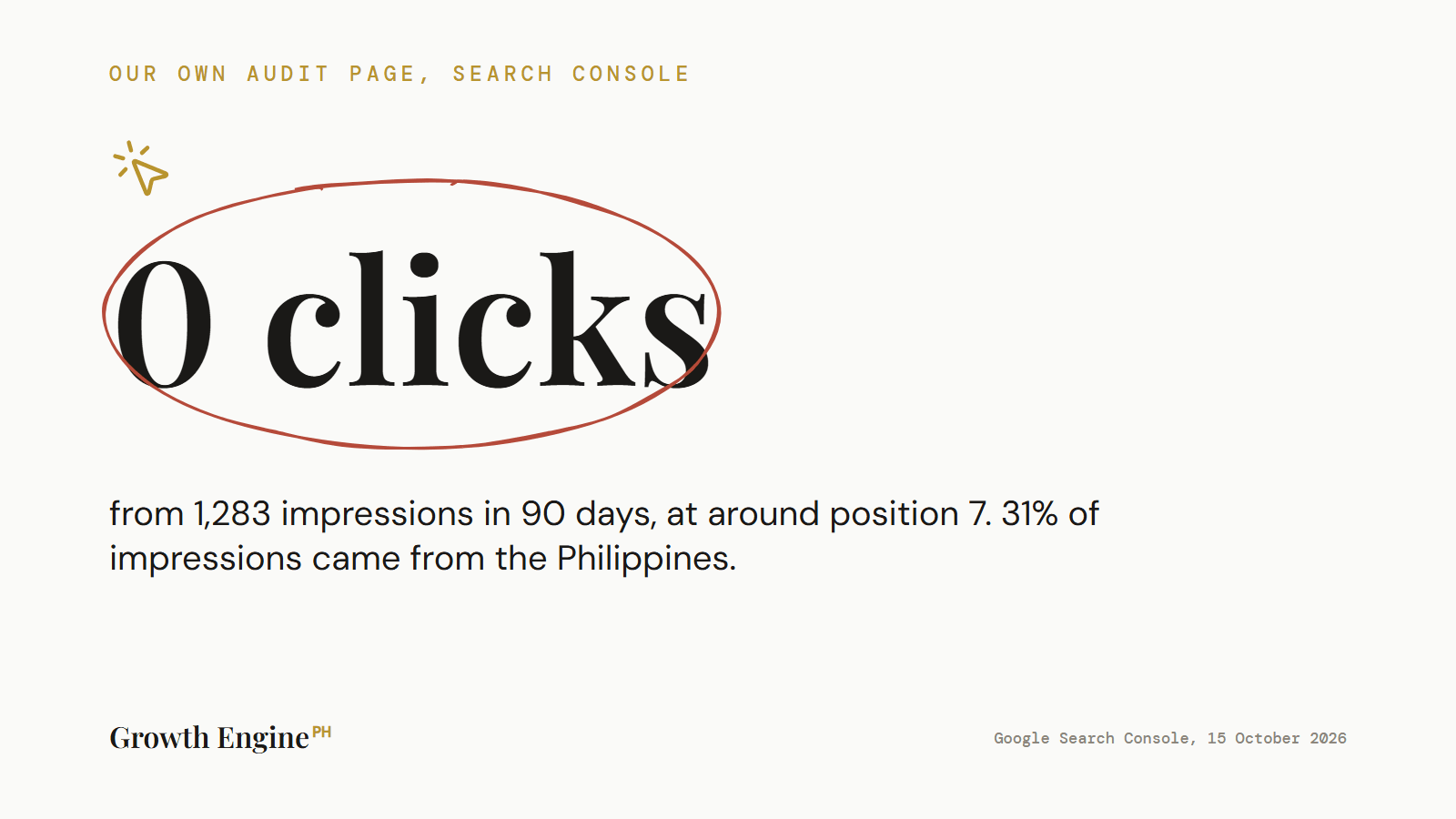
In mid-August our audit page for “technical seo audit philippines” settled around position 7 on Google. By mid-October it had 1,283 impressions in 90 days and no clicks. An impression is one time Google shows your page in the results.
I checked the usual suspects. A weak title. A slow template. Nothing was wrong. The page loaded, the title matched the search, and the content was accurate.
Then I looked at who was searching. Only 31% of the impressions came from the Philippines. Another 22% came from the UK and 21% from the US. 64% were on desktop. These were people at work, abroad, deciding whether to hire an auditor in the Philippines.
Our audit page had been written for Philippine site owners, and it led with a checklist. Google’s AI answer was already giving that checklist away. So the page answered a question the searchers were not asking.
I rewrote it for the real reader: what an audit from the Philippines is worth, what a crawler misses, what audits cost in four markets, and who makes the fixes. No report flagged that problem. Deciding who the page was for was the work.
That is what AI replaced. The generic answer used to earn a click. Now it is on the results page, so a page that only repeats it earns nothing.
| Work | What AI changed | Still needs a person |
|---|---|---|
| A generic answer to “what is X?” | Free on the results page | No |
| A keyword list | Fast to produce | Choosing which keywords pay |
| A first draft | Fast to produce | Deciding who it is for |
| A technical crawl | Fast to produce | Deciding what to fix first |
| A rank report | Fast to produce | Deciding which number to believe |
What can AI still not do in SEO?
AI cannot decide who a page is for, which number to believe, or what to leave undone, and it cannot be held accountable for the result.
The audit page was the first proof. Here is the second.
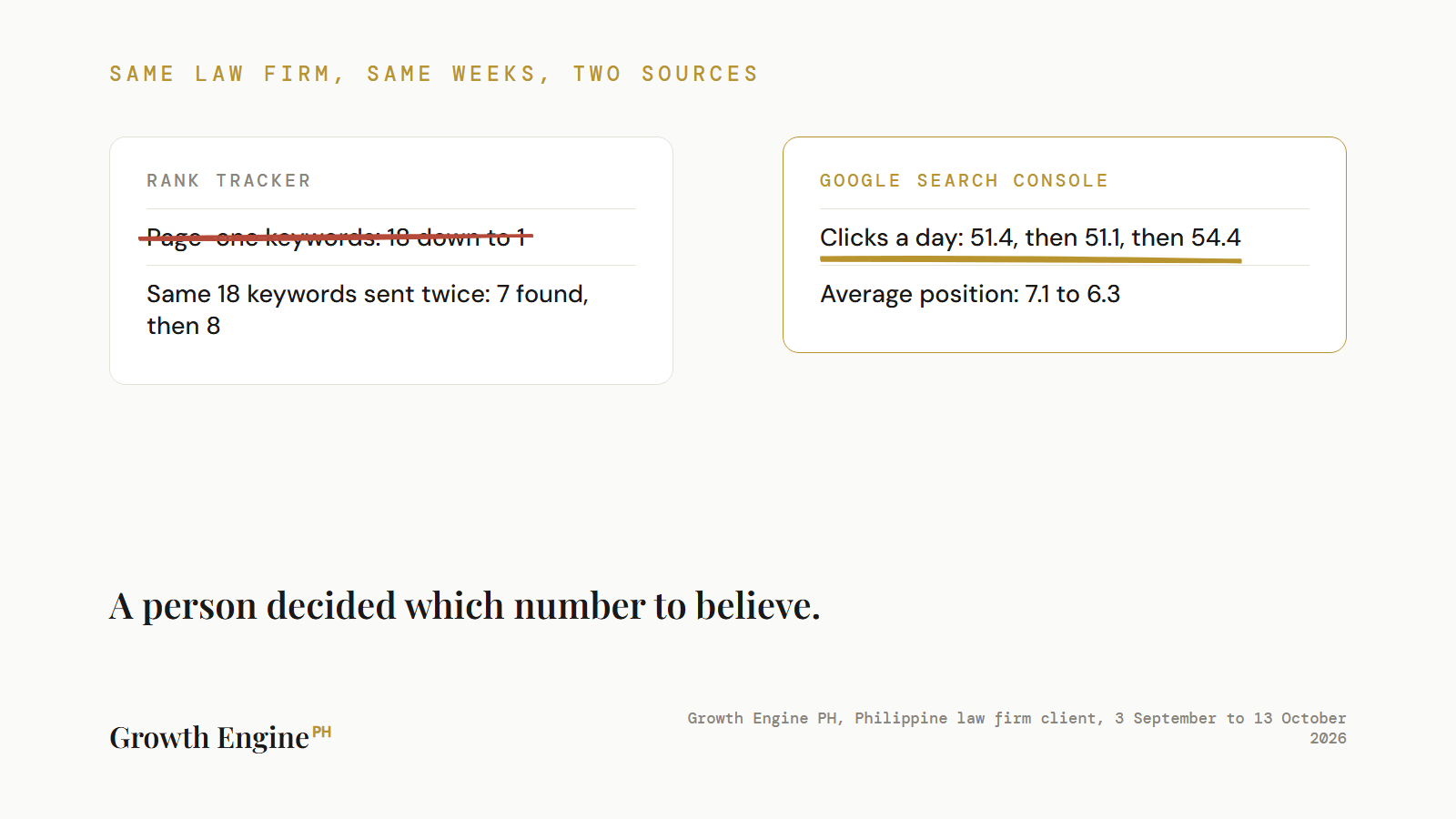
A Philippine law firm we work with watched its rank tracker report a collapse. The tracker said 18 of its keywords were on page one on 22 and 23 September. By 13 October it said 1. The Google September 2026 spam update was rolling out at the time, so the obvious reading was a penalty.
Search Console, Google’s own free report, said otherwise. The firm’s clicks ran at 51.4 a day from 3 to 23 September, 51.1 a day during the rollout, and 54.4 a day after it. Average position improved from 7.1 to 6.3.
We tested the tracker. We sent the same 18 keywords twice at the same time. One run found 7 keywords. The other found 8. The two runs disagreed keyword by keyword. The tracker was returning blanks, not lower positions. We wrote up these tracker blanks in full when the update ended.
No tool decided that Search Console was the number to trust. A person did, by asking why two sources disagreed. The rule we adopted: every daily ranking is checked against Search Console, and a tracker blank on its own no longer counts as a lost ranking.
AI visibility scores have the same problem. On our own site, Google AI Mode returned between 57 and 243 sources for the same 15 prompts across seven weeks, on one unchanged script. Any score built on one run carries an error bar that is wider than most changes people try to explain.
Three jobs stayed with a person: – Who the page is for. The audit page rewrite. – Which number to believe. The tracker against Search Console. – What to leave undone. Fixing the wrong page well is still the wrong work.
Will AI replace SEO consultants?
As of October 2026, AI is replacing a consultant’s hours of legwork, not the decisions, and nothing in our own work suggests the decisions are close to automated.
The strongest objection deserves a fair hearing. It says AI will do the judgment too, and soon. Tools already pick keywords, rank pages by priority and write reports. If they get good enough at deciding, the human part shrinks.
That may happen. I cannot rule it out, and I would not trust anyone who did.
What I can report is what we see. The calls that went wrong in our own work were the ones tools made without a second check. A rank tracker read a healthy firm as a failing one. An AI visibility score moved more than anything we had changed. Someone had to ask why, and someone had to be accountable for the answer.
What would change my view is simple to state. A tool that settles a month of disagreements between its own sources, and picks the right one each time, without a person checking. We have not seen it. This is our view as of October 2026, not a forecast.
Why does billing by the hour change first?
Any price built on hours of research, drafting and checking has to change first, because those hours now take minutes.
This is an economic point, not a complaint about anyone. A research pass, a first draft, a crawl and a pre-publish check used to take a person a long time. Now they take much less. What did not shrink is the cost of getting a decision wrong.
So the sensible question for any provider, whether a freelancer, an in-house team or a consultant, is: which part of this price is the decision?
If a quote lists hours of tasks, ask what each task produces and who decides what to do with it. If a quote lists outcomes, ask how they are measured and against which number. Our guide to SEO packages shows how to compare quotes line by line. Our plans are scoped from the problem, not from hours: you see the full fix list before you start, and how we scope is on the services page.
What SEO looks like when AI does the legwork
In our practice, AI does the research, the first drafts, the crawls and the pre-publish checks, and the consultant decides priorities and checks every number against a second source.
Here is how a week goes.
AI systems run the research pass, draft the pages, crawl the site and check each page before it is published. That is the checklist half, and it is fast.
I decide which pages matter, who each page is for, and what to leave alone. I read every report against a second source before I act on it. Once a week we record which Google AI answers cite us and which name us, and we report both as a range, not one number. A citation is a source link in the answer. A mention is our brand named inside the answer. Our method is published in full so you can check it.
None of this makes SEO cheaper to do badly. It makes the legwork cheap, so the work that remains is the work that was always the point.
What this means for the firms paying for SEO
Ask what each line item is, a checklist or a decision, and check any number you are shown against a second source.
Four checks you can run today:
- Which queries bring work. Informational clicks are falling. Pages that answer buying questions are a different job. Ask which pages your provider is working on, and why those.
- A second source. If a report says rankings fell, ask what Search Console says. If a score says AI visibility rose, ask for the range.
- Who decides. For every task, ask who chooses what to do with the result. If the answer is a tool, ask who checks the tool.
- Citations and mentions, separately. Being a source link and being named in the answer are different results with different causes. A report that blends them hides the half that matters.
If you are not sure where your own pages stand, start with a free audit. You will see what is wrong and what it costs before you compare anyone.
Frequently Asked Questions
Is SEO a thing anymore?
Yes. Google says “all existing SEO fundamentals continue to be worthwhile” for AI Overviews and AI Mode. What has changed is which work earns a click. Generic answers now sit on the results page, so pages need to offer something the AI answer does not.
Does SEO still matter in 2026?
It does, most for pages that answer buying questions. Pew found people clicked a traditional result in 8% of visits with an AI summary against 15% without. Informational clicks are down. Searches from people ready to hire are a different case, and they still need a page to land on.
Is AI replacing SEO?
AI has replaced the checklist half: generic answers, first drafts, keyword lists and crawls. It has not replaced the decisions about who a page is for, which number to trust and what to leave undone. In our own work, those decisions are where the tools went wrong.
Will SEO exist in 5 years?
Nobody can say for certain, and this is our view only. What looks stable is that people search, Google says the fundamentals still apply, and pages that answer a question well can be cited. How search is displayed will keep changing.
Who is actually clicking on blog posts in 2026?
Fewer people on definition-style queries. Pew found clicks fell from 15% to 8% of visits when an AI summary appeared. People still click when a page offers something the summary does not, like first-hand data or a clear decision.
Is SEO still worth paying for?
It depends on what the money buys. Ask whether each line item is a checklist, which AI now gives away, or a decision, which it does not. A provider should show you the full scope and the numbers it tracks before you start.
Will AI replace SEO consultants?
As of October 2026, AI is replacing a consultant’s hours of legwork, not the decisions. In our own work, a person had to settle disagreements between a rank tracker and Search Console. That could change, and we say so.
How much traffic do AI Overviews take?
It varies by query. Pew measured clicks on traditional results at 8% of visits with an AI summary against 15% without. Ahrefs found a 58% lower click-through rate for the top result on desktop, as a correlation. AI Overviews do not show on every search, so check your own Search Console data.
AI took the checklist. The decisions are still someone’s job. Before you pay for SEO, ask which is which.