By Mark Buraga, Independent SEO Consultant at Growth Engine PH
Last updated: 20 October 2026
A paid-ads freelancer sat in on a client’s SEO pitch this month. The pitch went well. Then came the quote: “5k+ per month” for the retainer. He asked a forum, “Is that normal?” The most useful reply didn’t judge the number at all: “The price means very little without the scope.”
That is the problem with comparing SEO packages. The tier names tell you nothing. What changes between tiers tells you everything.
What is included in a typical SEO package?
A typical SEO package bundles keyword research, on-page fixes, technical maintenance, content, links and a monthly report into one fixed monthly fee.
SEO packages are sold in tiers. The base tier covers the essentials. Each higher tier adds something. That addition is the part to read, because it is what you pay extra for.
Every step between tiers does one of two things. It adds more of the same work, such as extra posts or links. Or it adds different work, such as deeper technical fixes or AI search visibility. Both can be worth paying for. Neither is worth paying for unless the step is tied to a target you can check.
AI search makes this harder to judge. Many packages now include some form of AI visibility tracking, and those numbers move a lot. On our own site, Google AI Mode returned 57 to 243 sources for the same 15 prompts across seven weeks, on one unchanged script. As of October 2026, any package that reports AI visibility should report it as a range, not one number.
This guide covers what each tier changes, what packages cost in the US, UK and Singapore, which line items earn their place, and the questions to ask before you sign.
How much do SEO packages cost?
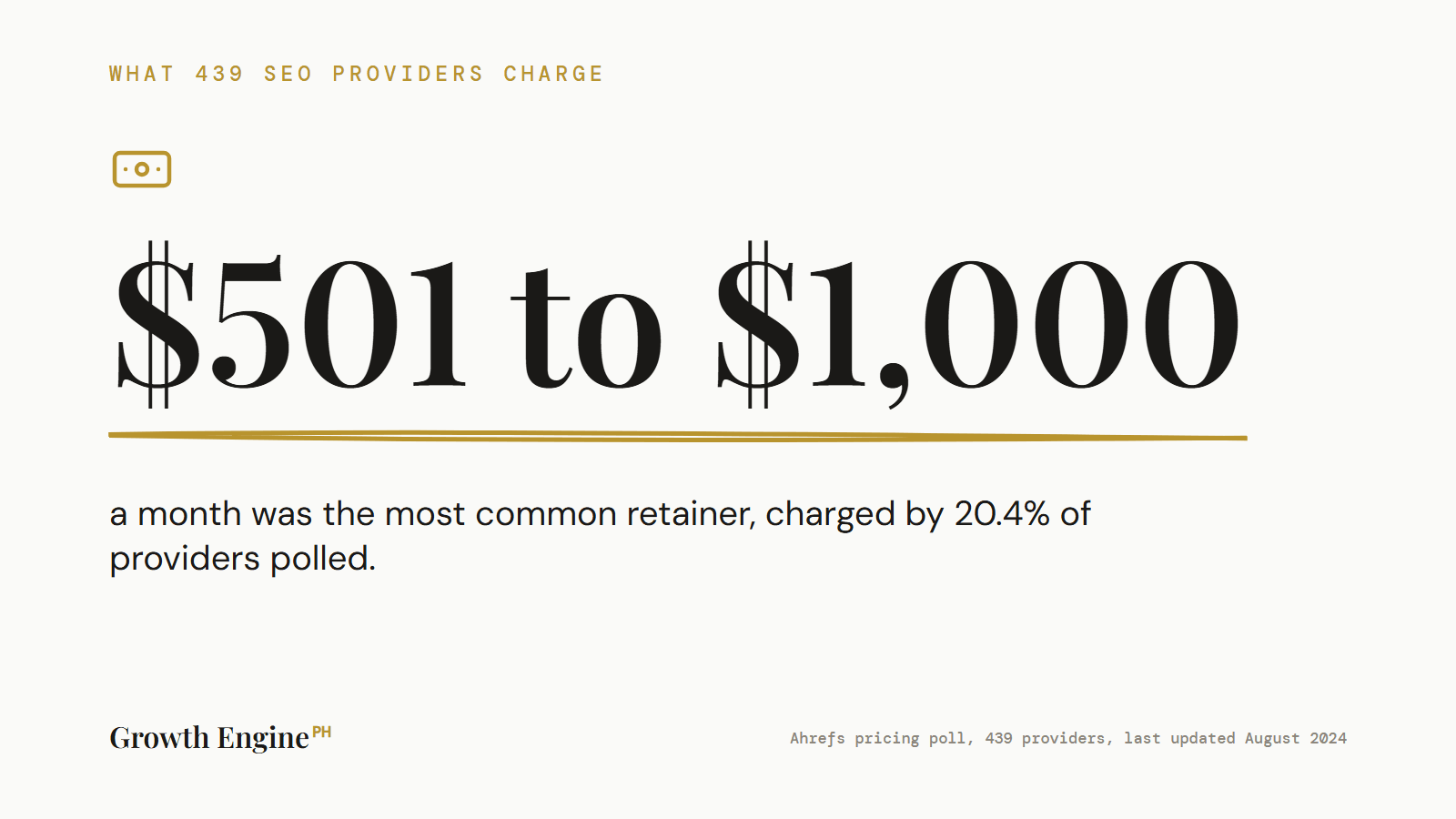
Most published SEO packages run from about $750 to $5,000 a month in the US, with competitive and enterprise tiers above $10,000, and the most common retainer among providers sits at $501 to $1,000.
NewMedia, a US agency, lists typical tiers as Starter at $750 to $2,000 a month, Growth at $2,000 to $5,000 and Competitive at $5,000 to $12,000 or more (NewMedia, August 2026). An Ahrefs poll of 439 SEO providers found $501 to $1,000 a month was the most common retainer, charged by 20.4% of them (Ahrefs, last updated August 2024, poll date not stated).
The SEO package price on a sales page is not always the monthly price. One US provider lists packages from $149 to $999 a month, “When Billed Annually” (Mainstreethost, October 2026). Compare quotes on the same basis: monthly, before tax, for the same term.
Prices in the UK and Singapore are in the market section below.
What actually changes between SEO package tiers?
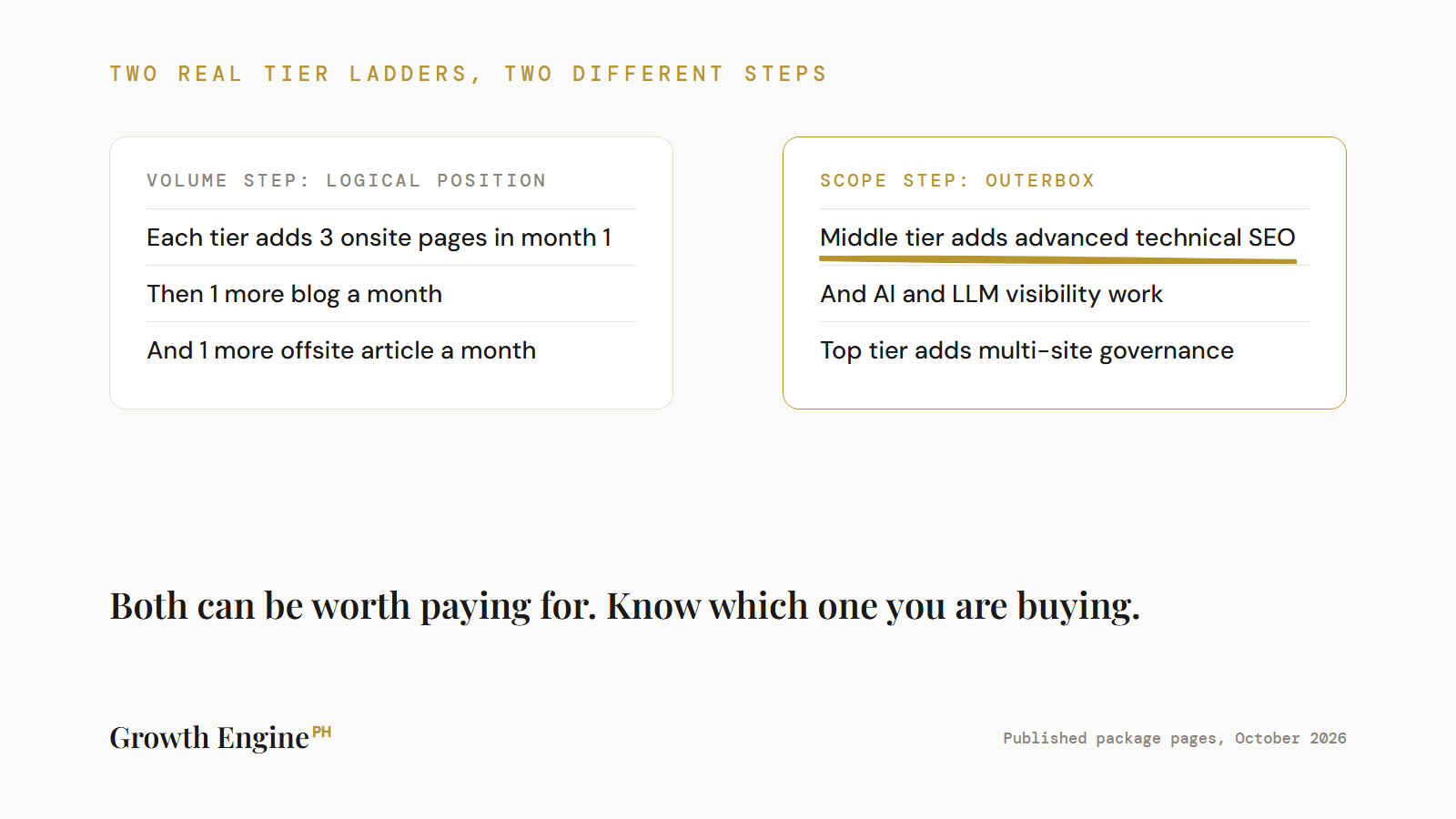
Each tier step adds either more of the same work, such as posts and links, or different work, such as technical fixes or AI visibility, and the quote should say which.
Published tiers show three patterns.
Volume steps. Logical Position’s five national SEO tiers each add three onsite pages in the first month, then one more blog and one more offsite article a month (Logical Position, October 2026). A provider on Reddit described the same shape for a local garage: “$150/month for one blog post”, “$700/month for 3 blog posts and 3 backlinks”, “$1300/month for 5 blog posts and 6 backlinks” (r/WebsiteSEO, October 2026).
Scope steps. OuterBox’s tiers run $2,000, $3,000 and $7,000 or more a month. The middle tier adds national keyword strategy, advanced technical SEO and “AI and LLM visibility work”. The top tier adds multi-site governance and scaled content (OuterBox, October 2026).
Quality steps. Loganix keeps two links a month at both of its tiers. The $1,000 tier places them on sites with more traffic than the $500 tier (Loganix, October 2026).
None of these is wrong. They answer different problems. A volume step helps a site that needs more pages. A scope step helps a site with problems the base tier doesn’t touch. The trouble starts when a buyer can’t tell which kind of step they are paying for.
When a higher tier adds more content or links, what is it tied to?
Extra posts and links are worth paying for when each one is aimed at a named keyword, page or prompt and measured, and not when the tier simply calls for more.
More content and more links do help. A bigger site in a harder market needs more of both. So a volume step is not a warning sign by itself.
The question is what the extra volume is for. Ask for the target behind it. Which keywords will the extra posts go after? Which pages will the extra links point to? What should move, and by when?
Google suggests the same test. Its guidance on hiring an SEO tells buyers to ask, “What kind of results do you expect to see, and in what timeframe? How do you measure your success?” It also says, “No one can guarantee a #1 ranking on Google” (Google Search Central, June 2026).
Links need one more question. Google lists “Buying or selling links for ranking purposes” as link spam (Google Search Central). If a higher tier adds links, ask which sites they will sit on, who owns them, and whether any placement is paid.
Volume tied to a target is a plan. Volume without one is a quota.
Which SEO package line items are worth paying for?
The line items that earn their place are the ones tied to pages that bring work: keyword research against real demand, fixes to service pages, content aimed at buying questions, and reporting that shows rankings, citations and mentions separately.
Buyers who have paid for SEO tend to say the same thing. On r/smallbusiness, one owner wrote that keyword research “was honestly the most valuable part for us,” because it showed what people actually searched for versus what the business assumed, and “it was completely different” (r/smallbusiness, January 2026).
Look for these in any tier:
- Keyword research against real search demand, mapped to the pages that should rank.
- Fixes to the pages that bring work, listed by page, not described as “ongoing optimization”.
- Content aimed at buying questions, each piece built to answer one question.
- Technical fixes with a list, so you can check what was done.
- AI visibility as a named deliverable, with citations and mentions reported separately and as a range.
- A report that leads to decisions, not a page of charts.
Which line items are padding?
Padding is any line item you cannot check: an unspecified “monitoring”, a keyword count with no target pages, links with no named sites, or reports with no decisions in them.
An in-house SEO on r/SEO listed what their company’s “five figures a month” retainer delivered: “80 keywords a month and auditing interlinking”, “Like 5 Reddit comments”, content feedback on two articles every other week, and “Buying zero click backlinks from spam sites” (r/SEO, August 2026). One reply summed it up: “The problem isn’t the $10k, it’s whether they’re delivering $10k.”
The price was never the issue. The line items were.
Common padding looks like this:
- A keyword count with no list of target pages.
- “Monitoring” or “auditing” with no output you can see.
- Links by the month with no named sites.
- Reports that show activity but never recommend a change.
If the package includes AI search work, the padding gets harder to spot. We cover that in AI-search red flags.
SEO packages by market
Published SEO package prices run highest in the US, sit in a similar band in the UK before 20% VAT, and start lower in Singapore, where quotes are usually shown before 9% GST.
All figures are published ranges as of October 2026. Compare them in local currency, before tax, and on a monthly basis.
SEO packages in the US
US package pages publish monthly prices from $149 to $7,000 and more, so compare the monthly price, the term and what each tier adds, not the headline number.
Published examples: OuterBox at $2,000, $3,000 and $7,000 or more a month; Loganix at $500 and $1,000 a month plus a $500 setup fee; Mainstreethost from $149 to $999 a month when billed annually. In the Ahrefs poll, 79.1% of US and Canada providers charged at least $1,001 a month.
Watch the term. Logical Position starts agreements at 6, 12 or 18 months. Loganix and OuterBox bill month to month. A lower price on a longer term can cost more than a higher monthly price you can cancel.
SEO packages in the UK
UK agencies typically charge £600 to £2,000 a month for small-agency packages and £1,500 to £5,000 at mid-market level, usually quoted before 20% VAT.
Red Eagle Tech’s 2026 summary puts enterprise agencies at £5,000 to £25,000 or more a month (Red Eagle Tech, July 2026). Many UK quotes are written ex-VAT, such as “£750 + VAT per month” (Surge Online, April 2026). The UK standard VAT rate is 20% (GOV.UK). Check whether each quote includes it before you compare.
SEO packages in Singapore
Singapore SEO packages run from about S$700 to S$1,500 a month at the basic end and S$3,000 to S$5,000 for advanced work, with GST at 9% and grant rules that changed on 29 September 2026.
MediaPlus Digital lists Basic at S$700 to S$1,500, Standard SME at S$1,500 to S$3,000, Advanced at S$3,000 to S$5,000 and Enterprise from S$5,000 a month (MediaPlus Digital, October 2026). One Singapore provider publishes a clean volume step: $2,800 a month for 20 tracked keywords and two articles, $3,800 for 40 keywords and four articles (BestSEO, October 2026).
Two local notes. GST is 9% (IRAS). And the Productivity Solutions Grant closed on 29 September 2026; Enterprise Singapore now directs new applications to the EDGE Grant (Enterprise Singapore). Pages that still describe PSG funding for SEO packages are out of date.
Should you choose a monthly SEO package or a scoped retainer?
A fixed monthly SEO package suits a small site with a simple goal, and a scoped retainer suits a firm whose pages and markets need different work, but both should name what each month delivers.
The case for packages is strong. A fixed monthly SEO package gives a small firm a number it can budget, compare and cancel. Custom quotes are harder to compare, and a seller can price by what the buyer seems able to pay. A published price is a courtesy to the buyer.
The case for scoped work is just as real. As one provider put it, “I don’t think SEO should be sold as the same package to everyone” (r/WebsiteSEO, October 2026). A law firm with five practice areas and a two-page brochure site do not need the same month.
Both are fair. The test is the same either way: does each tier, or each month, name what it adds and what that addition is for?
Our own plans are built scope first. Engine Fix starts from a full fix list you see before work begins, and runs until that list is done. Engine Care is month to month, with two tiers that differ by how many keywords we maintain. AI citations and mentions are tracked in both.
How to compare SEO packages side by side
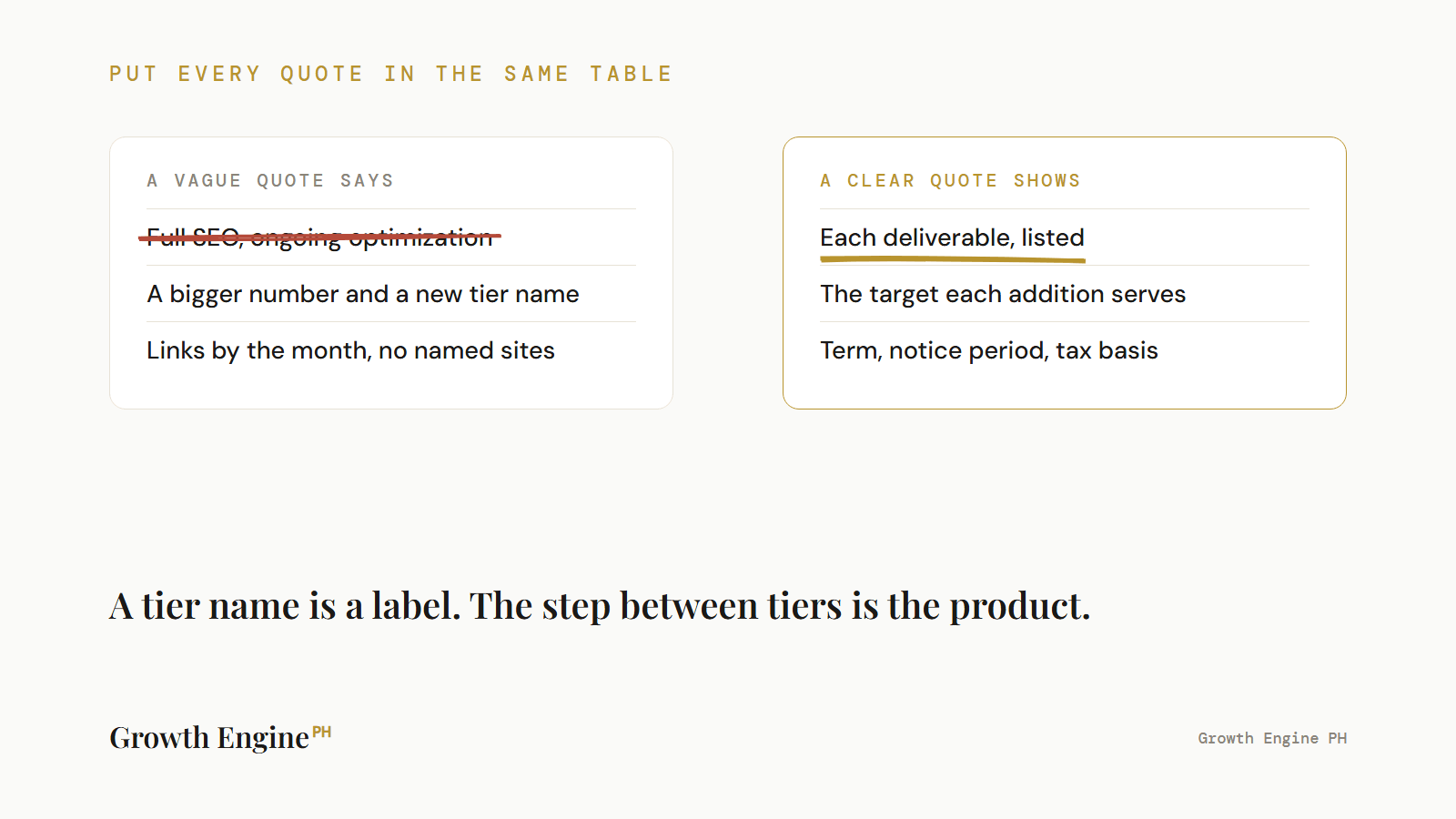
Put each quote in the same table: what the base tier includes, what each step adds, the target each addition serves, the term, and how results are reported.
| What to check | What a clear quote shows | What a vague quote shows |
|---|---|---|
| Base tier | Each deliverable, listed | “Full SEO” or “ongoing optimization” |
| The tier step | What the next tier adds, by item | A bigger number and a new name |
| The target | Keywords, pages or prompts each addition serves | No target, or “more visibility” |
| Links | Named sites, ownership, whether paid | A count per month |
| AI visibility | Citations and mentions, reported as a range | One visibility score, or nothing |
| Term | Monthly price, minimum term, notice period | An annual price shown as monthly |
| Reporting | Changes made and what to do next | Charts with no recommendation |
| Where Growth Engine PH stands | Scope shown before you start; Care tiers differ by keywords maintained; AI citations and mentions tracked in every plan |
To see how a scope-first plan reads, here is how we scope our two plans.
Questions to ask before you choose an SEO package
Ask what each tier adds, what it is aimed at, and how you will know it worked, and a vague quote usually shows itself by the third answer.
- What does the base tier include, item by item?
- What does the next tier add?
- What target does the extra work serve: which keywords, pages or prompts?
- Which sites will links come from, and is any placement paid?
- Is AI visibility included, and is it reported as a range?
- What is the term, and what is the notice period?
- Is the price monthly or billed annually, and before or after tax?
- What results do you expect, by when, and how will you measure them?
The last question is Google’s own. A provider that answers all eight clearly is worth a second call.
Not sure what your site needs yet? Start with a free audit before you compare any quote.
Frequently Asked Questions
What is an SEO package?
An SEO package is a fixed monthly bundle of SEO work. It typically covers keyword research, on-page and technical fixes, content, links and a monthly report. Its tiers differ by how much work they include, what kind of work, or both.
How much does an SEO package typically cost?
Published US packages run from about $750 to $5,000 a month, with competitive tiers above that, per NewMedia. In an Ahrefs poll of 439 providers, the most common retainer was $501 to $1,000 a month. What each tier includes matters more than the headline price.
Is $5,000 a month normal for an SEO package?
It can be. On r/localseo, one commenter listed law firm SEO fees from “$650-$1000” to “$11,000” a month. NewMedia puts competitive packages at $5,000 to $12,000 or more. The fee only means something next to the scope. Ask what happens every month for that money.
How much do SEO agencies charge for basic SEO services?
It depends on the market. Small UK agencies charge about £600 to £2,000 a month before VAT. Basic Singapore packages run about S$700 to S$1,500 before GST. In the US, starter tiers commonly sit between $750 and $2,000.
What is the cheapest SEO package?
Published US packages start at about $149 a month, billed annually, per Mainstreethost. Its four tiers run to $999 and do not list what each includes. At the low end, ask for the item list before you compare. Without it, two cheap packages can differ more than their prices.
Do SEO packages include AI search visibility?
Some do. One US provider adds AI and LLM visibility from its middle tier; others sell it separately. Ask whether it is included and how it is reported. Because AI answers change from run to run, it should be reported as a range. Here is our method.
Can I change or cancel an SEO package mid-term?
It depends on the term. Loganix and OuterBox bill month to month, and Loganix asks for 30 days’ notice. Logical Position starts agreements at 6, 12 or 18 months. One Singapore provider starts at 6 months, then moves to 30 days’ notice. Read the term before you compare prices.
How long before an SEO package shows results?
Ask the provider directly. Google suggests asking, “What kind of results do you expect to see, and in what timeframe?” Get the answer in writing, along with how they will measure it.
A tier name is a label. The step between tiers is the product. Before you compare package prices, ask what each step adds and what it is for.