By Mark Buraga, Independent SEO Consultant at Growth Engine PH
Last updated: 9 October 2026
If your AI SEO agency charges you for GEO separately, you may be paying twice for one job. If it charges for content by the word, it is optimizing the one thing Google says it does not count. Here are five more lines to check before you sign.
What should you check before hiring an AI SEO agency?
Check what each provider counts, because a proposal that bills for words, comments or a separate GEO line is charging for activity AI engines do not reward.
An AI SEO agency is a provider that works to get a site cited and named in AI answers, such as Google AI Overviews, AI Mode, ChatGPT and Perplexity, as well as ranked in search. Most proposals in this category use the same words. The difference shows in what each one bills for and what it reports.
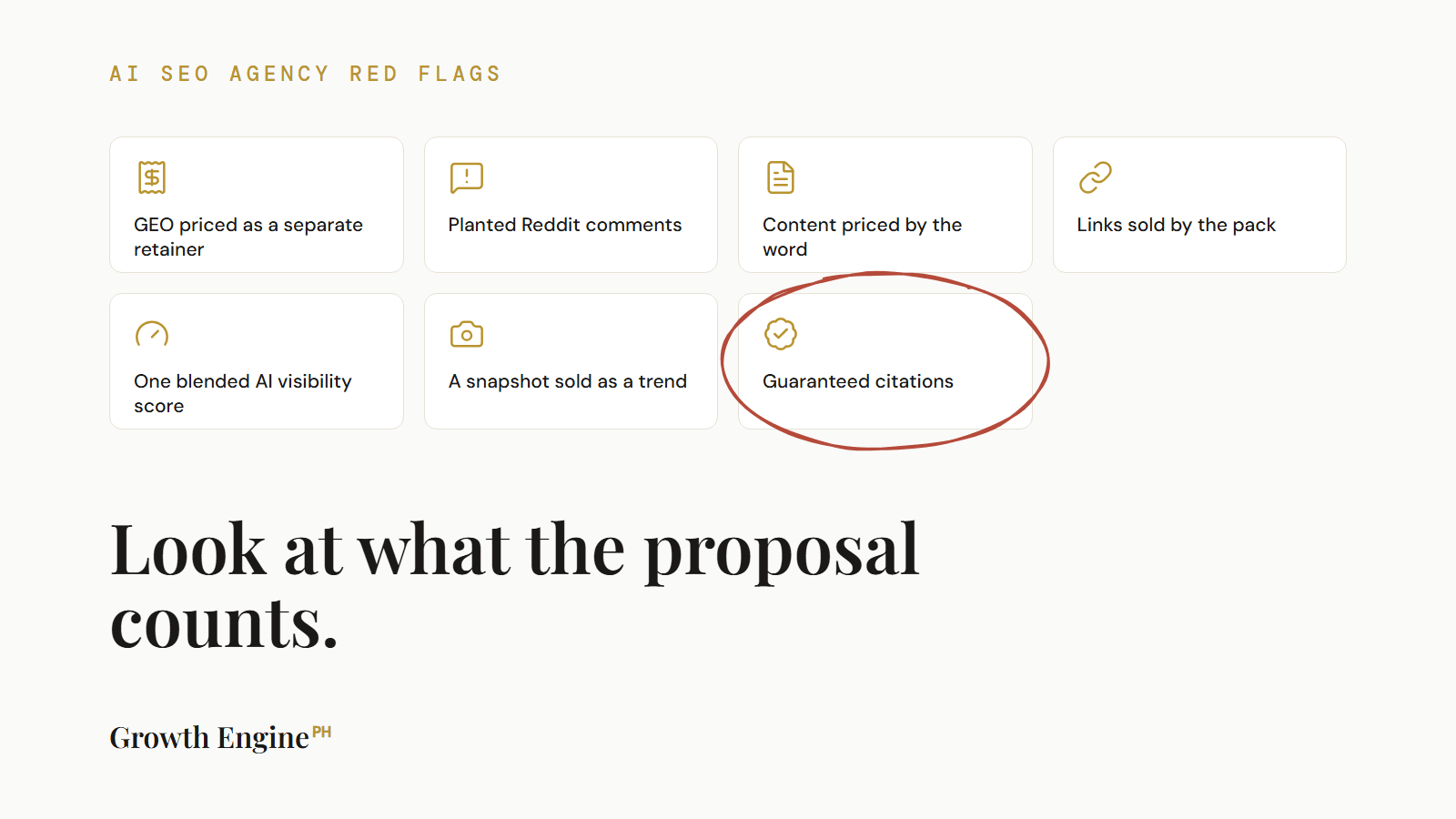
Weak proposals bill for what is easy to count: words written, comments posted, links by the pack, a GEO line on top of SEO you already pay for, one visibility score. AI engines reward none of those. They quote pages built to answer a question, and they name brands that other people mention unpaid.
Reporting needs the same care. On our own site, Google AI Mode returned between 57 to 243 sources for the same 15 prompts across seven weeks, on one unchanged script, as of September 2026. A single number from a system that moves that much tells you very little.
The seven red flags:
- GEO priced as a separate retainer
- Planted Reddit comments
- Word count as the unit of value
- Links sold by the pack
- One blended AI visibility score
- A single snapshot sold as a trend
- Guaranteed citations
If your agency charges for GEO separately, what are you paying for twice?
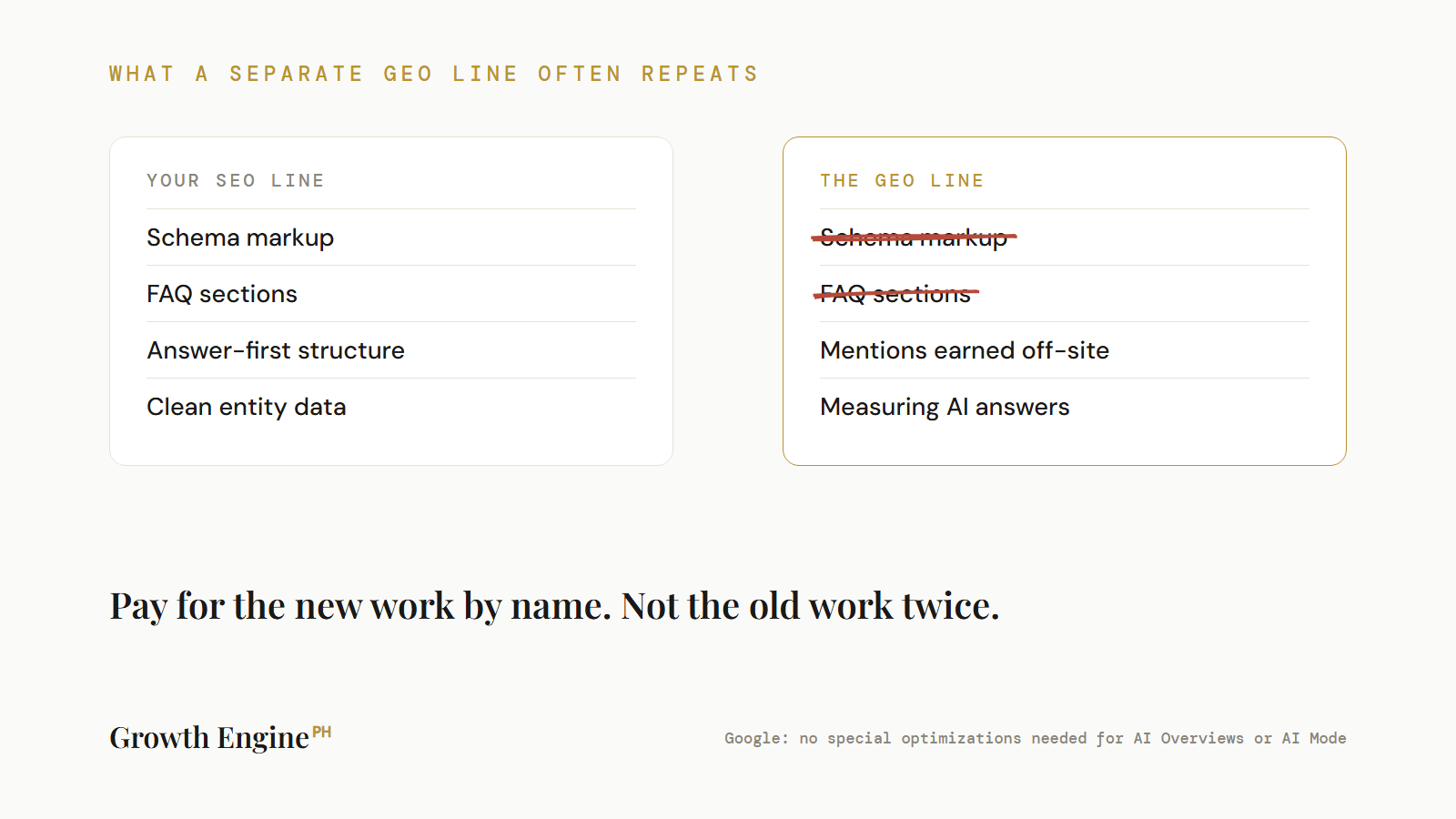
Google says AI Overviews and AI Mode need no additional requirements or special optimizations, so a GEO line that repeats on-page SEO work bills you twice for one job.
The source is Google’s own documentation on AI features: “There are no additional requirements to appear in AI Overviews or AI Mode, nor other special optimizations necessary” (Google Search Central, updated 10 December 2025). Schema, FAQs, answer-first structure and clean entity data are SEO work. They were in good SEO plans before anyone called them GEO.
The market prices GEO as its own line anyway. WebFX publishes GEO services “Starting at $3,000/month” and a typical agency range of $1,500 to $50,000+ a month (WebFX, May 2026). The price sits on top of the SEO fee, so the buyer has to work out where one job ends and the other begins.
The question to ask: “What does the GEO line deliver that the SEO line doesn’t, deliverable by deliverable?” If the answer lists schema, FAQs and content structure, you are being sold the same work twice.
What is genuinely different about AI search work?
Two things are new, earning mentions off your site and measuring AI answers, and both deserve their own named deliverables.
A citation is your page linked as a source in an AI answer. A mention is your brand named inside the answer text. Citations come from structure on your own pages. Mentions come from other people talking about you, which is why mention mechanics work off-site. If the labels are new to you, start with the acronyms. Pay for the new work by name. Do not pay twice for the old work under a new name.
If your agency posts on Reddit for you, whose name is on the removed comments?
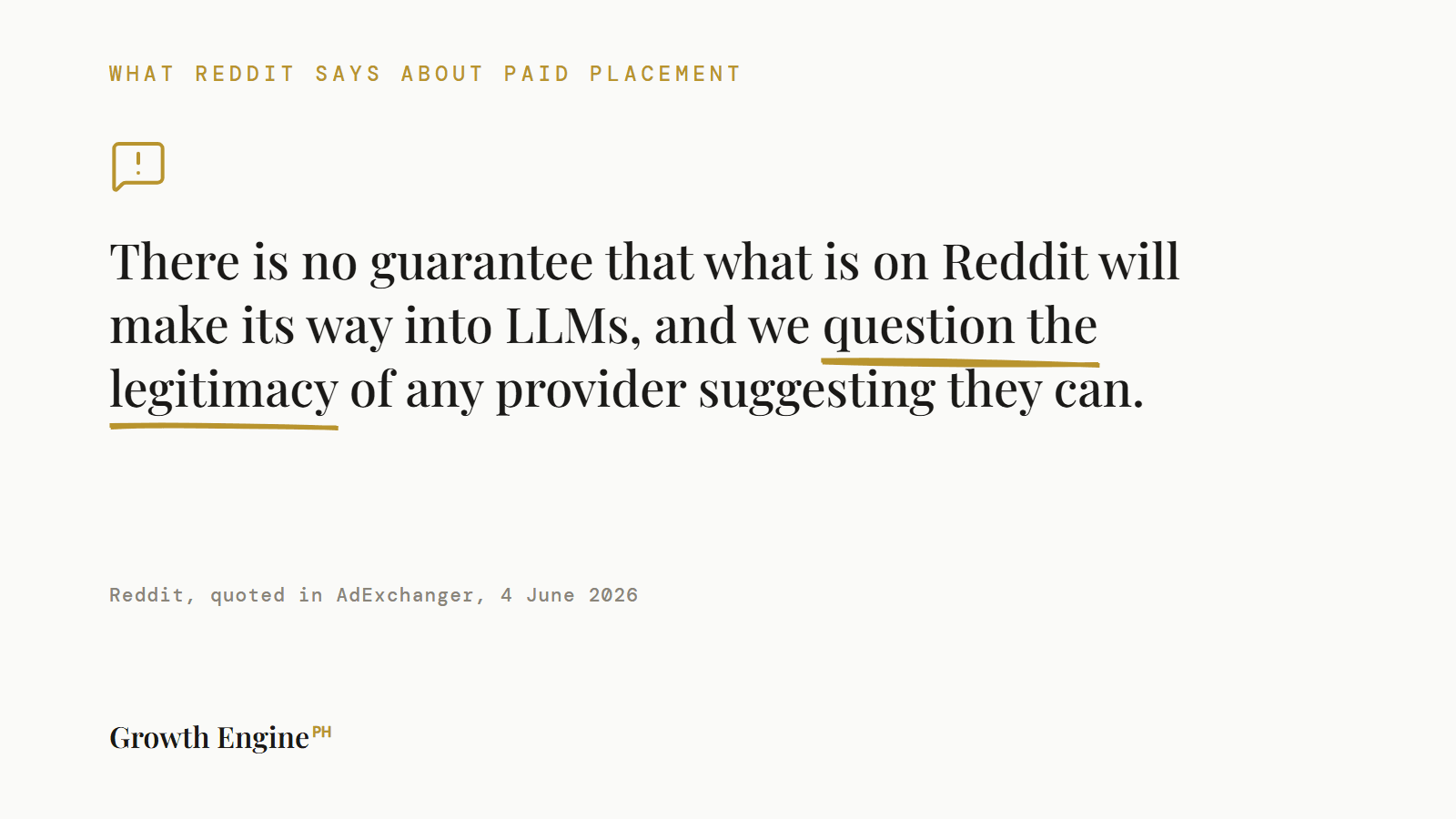
Reddit says it detects and removes coordinated brand posting at massive scale, so seeded comments tend to buy a removal record rather than a mention.
The pitch is easy to understand. Reddit shows up in AI answers often. In our own captures, reddit.com was one of the most-cited domains, with 34 appearances across 8 of 10 non-brand prompts. The Google AI Overview for “ai seo agency” itself describes these providers as building “community citations on platforms like Reddit” (observed 28 September 2026).
In early June 2026, the moderators of r/Biohackers stopped accepting new standalone posts about peptides and hormone therapy and moved the topic into a weekly megathread. They told 404 Media: “As AI search engines increasingly pull answers from Reddit, companies are using us for AEO.” One moderator described companies reverse-engineering “the actual prompt patterns that are prioritized by LLMs” (PPC Land, 3 June 2026).
Reddit’s reply was blunt. Its safety teams use “human review and sophisticated automated tooling to detect and remove this content at massive scale.” It added: “There is no guarantee that what is on Reddit will make its way into LLMs, and we question the legitimacy of any provider suggesting they can” (AdExchanger, 4 June 2026). Volunteers do the same work by hand. One moderator says they remove “20-30 posts a day that are fake questions or posts that only exist to name-drop specific brands” (moderator comment, 23 September 2026).
Reddit astroturfing also carries legal risk in the US, where the FTC’s 2024 rule bans fake testimonials and insider testimonials that hide the connection (FTC).
The question to ask: “Which accounts post, who owns them, and is the affiliation disclosed?” Disclosed participation by named people is legitimate and lasts. Seeded posts from accounts your agency runs are what gets removed.
If your agency charges for content per word, what is it optimizing?
Google says it has no preferred word count, so a retainer that prices and reports content by the word is paying for the one variable the engine says it ignores.
Google’s helpful content guidance asks writers: “Are you writing to a particular word count because you’ve heard or read that Google has a preferred word count? (No, we don’t.)” (Google Search Central, updated 10 December 2025). Backlinko’s study of 11.8 million results found an average top-10 length of 1,447 words, with word count “evenly distributed among the top 10 results” (Backlinko). Length does not separate the winners.
Per-word pricing is still common. SEO articles average $0.35 a word, yet per-word is the main pricing model for only 18% of writers (bestwriting.com, 2026, summarizing two writer surveys we have not opened directly). It is a fair way to price a writer’s time. It is a poor way to define success.
AI answers lift passages, not whole articles. Each section has to answer one question cleanly enough to quote. There is no ideal blog post length, only the length it takes to answer the question.
The question to ask: “Which question does each piece answer, and which prompt is it built for?”
If your agency sells links by the pack, where do those links come from?
Google lists buying or selling links for ranking purposes as link spam, so a bundle of links sold at a fixed price per pack is a question about sourcing, not a bargain.
Google defines link spam as “the practice of creating links to or from a site primarily for the purpose of manipulating search rankings.” Its examples include “Buying or selling links for ranking purposes” and “Low-quality directory or bookmark site links” (Google spam policies, updated 28 August 2026).
The number of links is not the problem. A plan can include a set number of links a month and be sound. Our guide to SEO packages shows what each tier changes. The problem is where they sit. A private blog network is a set of sites run by one operator mainly to pass links. Placements like that are cheap because nobody reads those sites. NewMedia names “20 backlinks per month for a few hundred dollars” as a sign of spammy links (NewMedia, August 2026).
The risk lands on your domain, not the seller’s. If Google discounts or penalizes the links, your site carries the loss and your provider moves on.
The question to ask: “Name three sites these links will be on, who owns them, and whether any placement is paid.” A good answer names real publications and welcomes the check.
If your agency reports one AI visibility score, which half is moving?
A citation and a mention are earned by different work, so one blended score cannot show which is moving.
Our own numbers show why. Across eight captures, Growth Engine PH was cited on 39 of 40 brand prompts and on 5 of 80 buying prompts. Blend those and the score looks healthy. Split them and the buying half, the half that brings clients, sat near zero.
Most dashboards cannot see this split at all, which is why so many measure the wrong half of AI search. A blended score can rise on brand prompts while buying prompts stay flat, and the report will still look like progress.
The question to ask: “Show me citations and mentions separately, split by brand and non-brand prompts.”
If your agency reports one snapshot, is it a trend or noise?
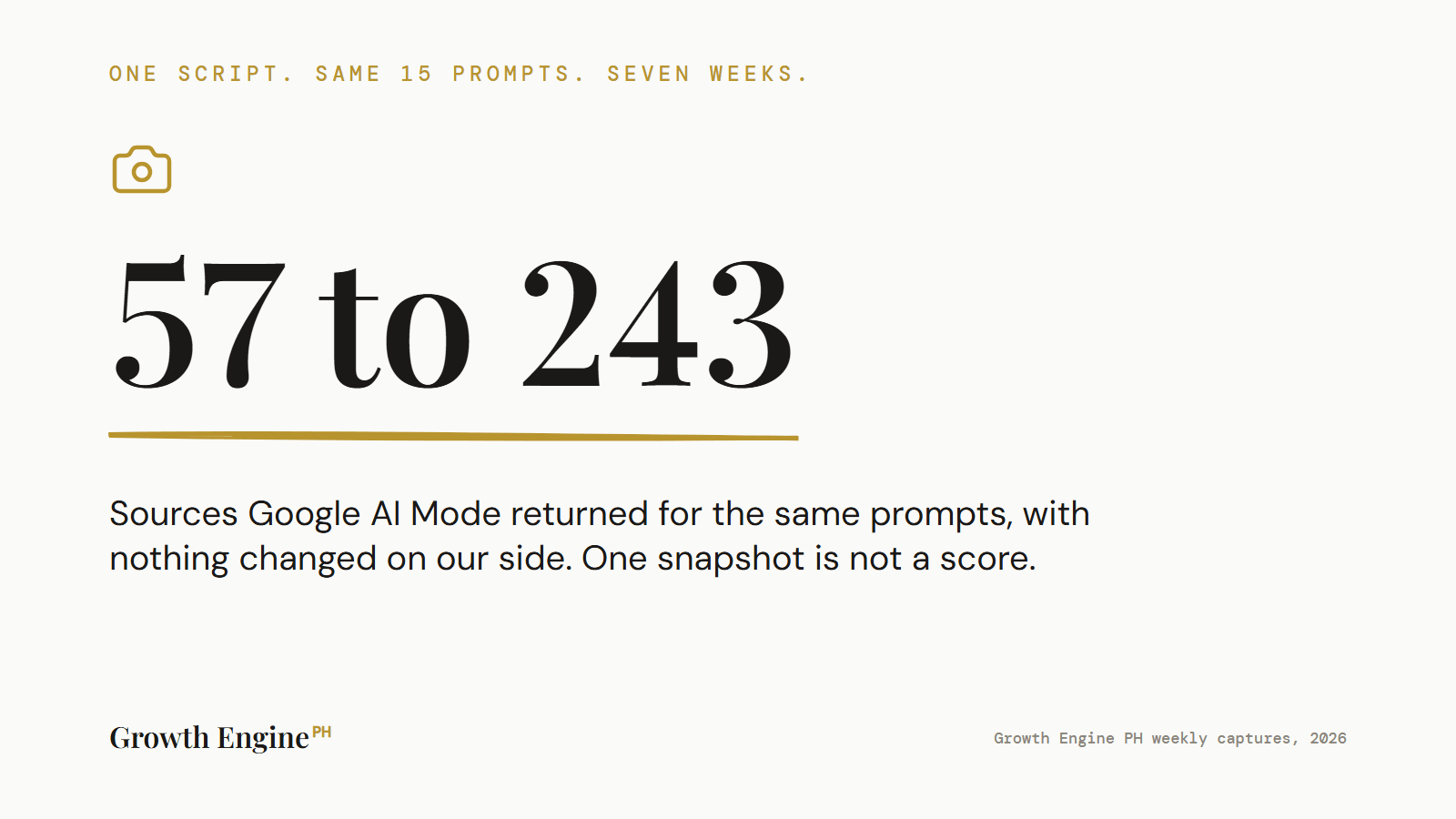
AI answers change from run to run, so a single reading is a screenshot, not a score; ask for a range across repeated captures on a fixed prompt set.
We measured this on our own site. On one unchanged script and a frozen set of 15 prompts, Google AI Mode returned between 57 and 243 sources over seven weeks. The same five citations read as 8.8% one week and 2.1% another. Nothing on our side changed. Only the denominator moved.
In a thread of buyers comparing providers, one commenter called a single visibility percentage “a screenshot” (r/automation, September 2026). A screenshot taken in a good week looks like growth. Taken in a bad week, it looks like decline. Neither tells you what the work did.
We publish the full procedure, prompt set and capture conditions included, as our method. Hold any provider, us included, to the same standard.
The question to ask: “Can I see the prompt set, the capture dates and the range?”
If your agency guarantees ChatGPT citations, who is actually in control?
No provider controls what an AI engine cites, so a guarantee of citations or mentions is a sales claim, not a deliverable.
The same buyer thread put it this way: “Guarantees. Nobody controls LLM behavior; ‘we’ll get you cited by ChatGPT’ is a lie by construction” (r/automation, September 2026). Reddit said the same about its own platform: there is “no guarantee” that its content reaches LLMs.
An honest commitment looks different. It names deliverables you can check, reports a measured range rather than a promise, and tells you the point at which you stop paying if nothing moves.
The question to ask: “What exactly do you deliver, and what happens if the numbers do not move?”
Where the other side has a point
AI search does add work a classic SEO retainer skipped, mainly earning off-site mentions and measuring AI answers, and it is worth paying for when it is scoped and reported by name.
WebFX makes the case well: “Optimizing for GEO differs significantly from traditional SEO. Instead of focusing primarily on keywords and rankings, GEO prioritizes how content is structured, understood, and selected by AI systems” (WebFX, April 2026). That is fair. ChatGPT and Perplexity retrieve differently from Google, and Google’s statement covers only Google’s own AI features.
Reddit participation can be legitimate too. A partner who answers questions in their field, under their own name, with the firm disclosed, is doing exactly what communities want. And word count is a reasonable way to price a writer’s time.
So the point is not that AI search work is fake. The new work is real. It should be named, scoped and measured. What should not happen is the on-page half, which Google says needs nothing special, being sold a second time under a new label.
What an AI SEO agency should count instead
Pay for three things you can check: pages built to be quoted, mentions earned from people you did not pay, and a measured range of both across a fixed prompt set.
| Red flag | What the weak proposal counts | What to ask for instead | How to check it |
|---|---|---|---|
| GEO add-on | A separate GEO fee | New work named line by line | Compare GEO and SEO deliverables side by side |
| Reddit seeding | Comments posted | Disclosed posts by named people | Ask which accounts post |
| Per-word content | Words written | Questions answered, prompts targeted | Read each brief’s target question |
| Link packs | Links per pack | Named sites with known owners | Ask for three sites before you buy |
| Blended score | One visibility % | Citations and mentions, split | Brand vs non-brand, separately |
| Snapshot | One reading | A range across repeated captures | Ask for the prompt set and dates |
| Guarantee | Promised citations | Named deliverables and an exit point | Read the contract terms |
| Where Growth Engine PH stands | AI visibility tracked in every plan; method, prompt set and range published | Read every plan and our method |
Nine questions to ask before you sign
Ask the questions in this order and a weak proposal usually shows itself by the third.
- What does the GEO line deliver that the SEO line doesn’t?
- Who posts on third-party platforms for us, from which accounts, with what disclosure?
- How is content scoped, by question or by word?
- Do you report citations and mentions separately?
- Do you split brand and non-brand prompts?
- Can we see the prompt set and the capture dates?
- Do you report a range or a single number?
- Where will our links be placed, who owns those sites, and is any placement paid?
- What happens if nothing moves in six months?
If you want to put these to us, book a scoped consult. We will answer all nine in writing.
Every flag here is the same flag: billing for what is easy to count. Pay for pages an engine can quote and names people mention unpaid.
Frequently Asked Questions
What should I look for when hiring a GEO agency after a bad experience?
Look at what the proposal counts. If the GEO line repeats on-page SEO work, which Google says needs no special optimization for its AI features, ask what it adds. Then run the nine questions above. A weak proposal usually fails by the third.
Which GEO agency is actually worth hiring for AI search visibility?
One that reports citations and mentions separately, across a fixed prompt set, as a range. On our own site, the sources returned for the same 15 prompts ranged from 57 to 243 in seven weeks, so a provider that reports one number is reporting noise. Judge on method, not on a ranked list. Many best-agency lists are written by firms that rank themselves.
How do you tell if one AI SEO agency is better than another?
Ask what each one will show you. The strong ones share the prompt set, the capture dates and a range. The weak ones share one percentage and a screenshot.
How much does AI SEO cost?
Published agency ranges run from $1,500 to over $50,000 a month, per WebFX. The better question is whether the GEO portion is priced on top of SEO for the same work. Our own plans and prices are on our services page.
What is an AI SEO agency?
A provider that works to get a site cited and named in AI answers, such as Google AI Overviews, AI Mode, ChatGPT and Perplexity, as well as ranked in search. The work splits into citations, earned on your own pages, and mentions, earned from other people.
Should GEO cost extra on top of an SEO retainer?
Only for work SEO does not cover: earning mentions off your site and measuring AI answers. Google says appearing in AI Overviews needs no special optimization beyond normal SEO, so schema and content structure should already be in the plan.
Are cheap backlink packages safe?
Google lists buying or selling links for ranking purposes as link spam. Before you buy, ask where each link will sit, who owns the site and whether the placement is paid. If the provider will not name the sites, do not buy.