By Mark Buraga, Independent SEO Consultant at Growth Engine PH
Last updated: 27 October 2026
On 11 October we audited our own site. The crawl came back with 436 URLs. The audit came back with 15 findings, none critical, and a short list of eight to fix first. Only five of the 15 were in the crawl files.
That gap is what you are paying for when you buy an SEO audit report. This post shows how to see it in a quote, a sample or a finished report, before the money moves.
What is the difference between an SEO audit and a tool export?
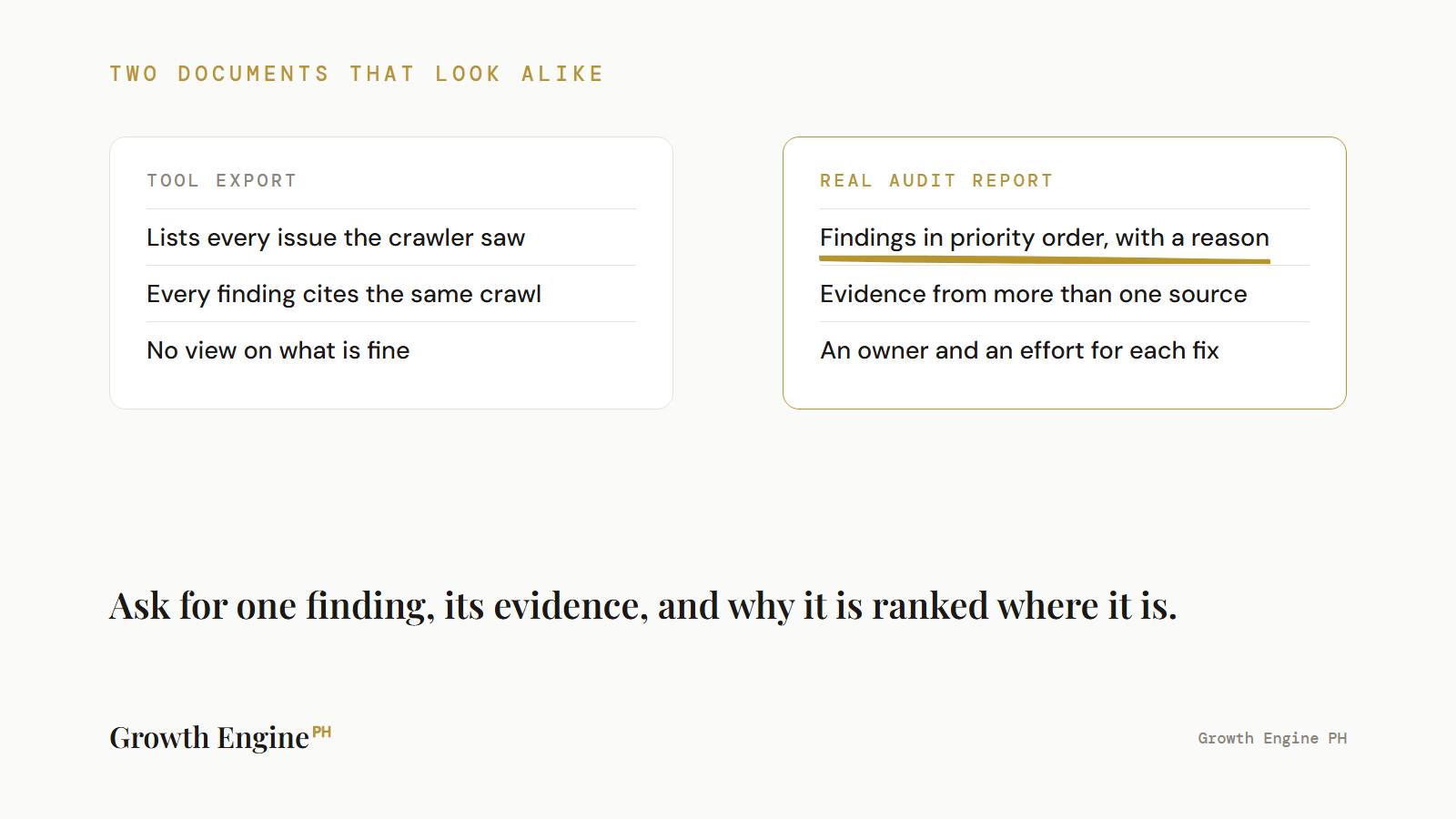
A tool export lists what a crawler can see on your pages. An SEO audit report ranks what to fix, says who fixes it and what it should move, and uses evidence the crawler never had.
A crawler is software that visits every page on a site and records what it finds: titles, links, redirects, errors. Its export is useful. Google teaches the same checks in its own technical audit video (Google Search Central, November 2025). The checks are public.
The buyer’s problem is that a nicely formatted export looks like an audit. One in-house marketer, forwarded a $2,400 audit pitch by their boss, asked whether it was “the same crawl in a nicer document” (r/WebsiteInsights). Sometimes it is. The rest of this post is how to tell.
What did a real audit of our own site find that a crawl could not?
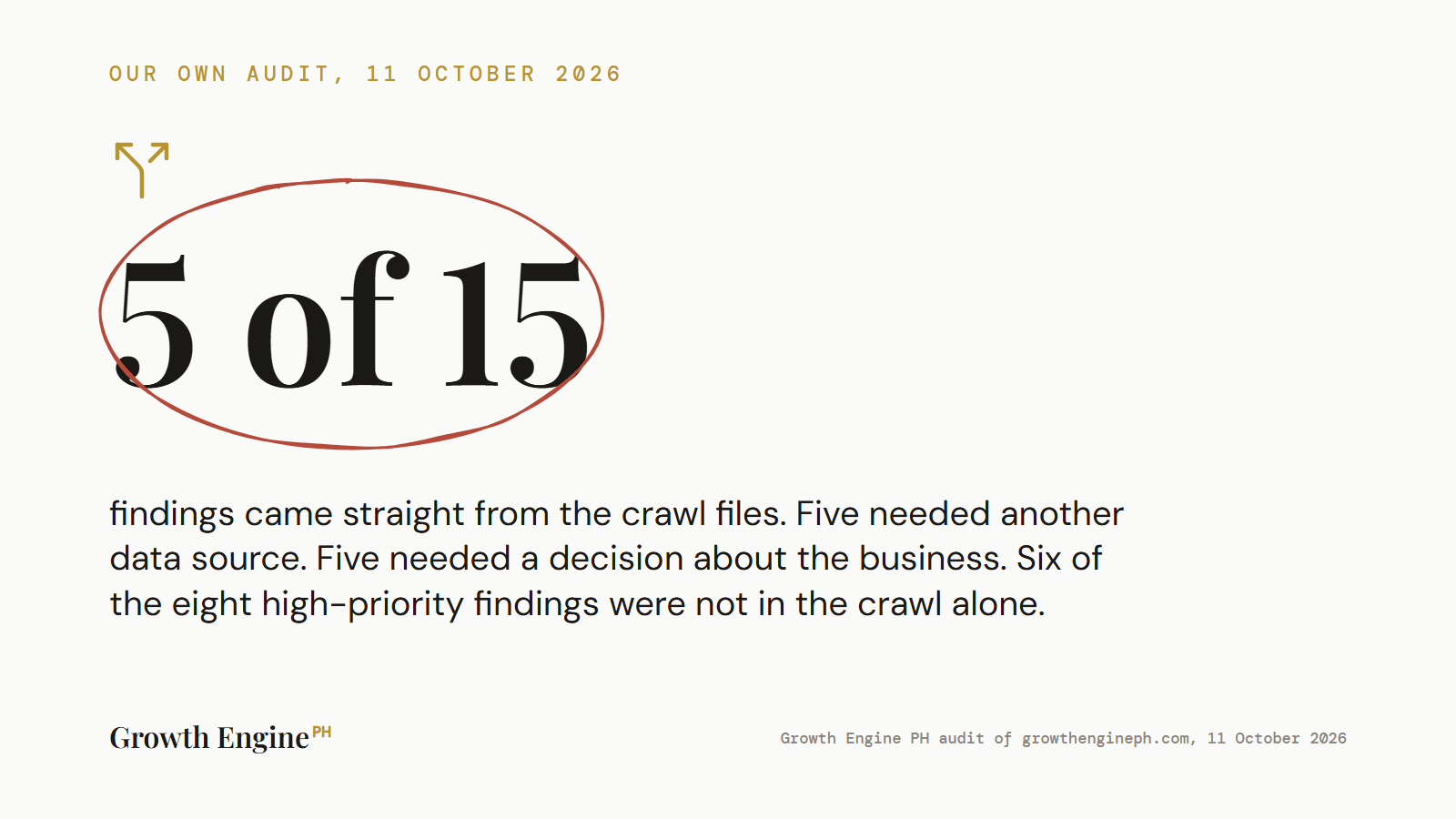
Of 15 findings in our own audit, five came straight from the crawl files. Ten needed another data source or a decision about the business.
We crawled growthengineph.com on 11 October 2026. The crawl recorded 436 URLs, of which 87 were pages: 76 indexable pages, 9 redirects and 2 broken links. We then audited the site against everything else we could get: backlink data, page speed tests, the page source and what the business has stopped selling. Here is how the 15 findings split. The split is our own classification.
| Where the finding came from | Findings | Examples |
|---|---|---|
| Straight from the crawl files | 5 | Two internal links to pages that do not exist; 21 pages without a meta description; 10 titles over 60 characters |
| Needed another data source | 5 | About 1,200 spam referring domains that arrived after our last link clean-up (backlink data); colour contrast failing on all 15 pages we tested (page speed and accessibility tests); no sameAs links in our organisation schema (page source) |
| Needed a decision about the business | 5 | Retired offers still live, indexable and linked; one service page with only 2 internal links; 114 tag archive pages in the sitemap that nothing links to |
Now the part that matters. We rated each finding high or medium. Eight were high. Six of those eight were not in the crawl alone. The crawl gave us the loudest list. It did not give us the right order.
The audit also said something a tool export rarely says: no critical findings. The site was technically sound for its size, and the report listed what was fine next to what was not. A report that finds hundreds of “issues” on every site is counting. A report that says what to leave alone has judged.
What does a real SEO audit report contain?
A real SEO audit report names its reviewer, ranks every finding, shows the evidence for each, says who fixes it, and states what is fine.
Use this as the answer to “what should an SEO audit include” before you read any quote:
- A named reviewer. One person who looked at your site and will walk you through it.
- Findings in priority order. Not alphabetical, not by tool category. Each one has a reason for its place.
- Evidence beyond the crawl. Search Console, backlink data, page speed tests, or what the page source shows. If every finding cites the same crawl, it is an export.
- An owner and an effort for each fix. Who changes it, and whether it takes an hour or a month.
- What is fine. A short list of what was checked and passed, so you know the scope.
- What the audit did not cover. For example, server logs on a large site. An honest report draws its own edges.
Our own report carried all six, down to an owner and an effort label on each of the 15 findings. The checks themselves are the same ones every audit runs; for the list, see our guide to the technical audit.
How can you tell if an SEO audit report is just a tool export?
You can tell by testing the document, not the price: ask for one finding and its evidence, ask why it is ranked where it is, and ask what it is not telling you.
Buyers have been asking this for years. One person in r/SEO put it this way: “How do i filter out people doing genuine audits vs the ones generated by a tool.” (r/SEO). Here are five tests you can run on a sample page or a proposal:
- The same-crawl test. Does every finding point to a list of URLs and nothing else? If yes, it is a crawl.
- The order test. Ask why finding number one is number one. A real answer mentions your traffic, your pages or your goals. A tool answer mentions severity colours.
- The silence test. Is there anything the report says is fine? A report with no good news has not made a judgment.
- The business test. Does any finding depend on something only you could tell the auditor, like an offer you retired? Ours did. Three of our eight high findings did, and no software could have raised them.
- The next-step test. Does it say who makes each change? One founder who read 53 negative reviews of SEO tools found the same complaint: the tool finds the issues, the team has to prioritise and ship everything, “so the audit ends up sitting in a doc” (r/SaaS).
A person who has to judge a quote they cannot read needs a test they can run without reading code. These five need no technical knowledge. They need a sample and a few questions. If the provider also runs AI reporting, our post on what an AI SEO provider counts covers the questions to ask there.
When is a tool export enough?
A tool export is enough when the site is small and simple, you can prioritise the list yourself, and nobody is charging a four-figure fee for it.
The other side deserves a fair hearing. One commenter in r/SEO said a free crawler gives you the list of potential issues and that $3,000 for an audit is a lot (r/SEO). For a site of a few dozen pages that you built and still understand, they may be right. Run the crawl, read the top errors, fix the broken links. That costs nothing.
The export stops being enough when any of these is true:
- The site has been built or edited by several people over the years, so you cannot say what is supposed to be there.
- You have retired an offer, changed a service or moved platforms, and old pages still exist.
- Leads come from search, and you cannot tell which errors cost you leads and which do not.
- The list is long and you do not know where to start. Another buyer wrote: “You’ve had a long audit … that you couldn’t judge. Then it goes back on the pile because the business needs you.” (r/smallbusiness)
That last point is the hidden cost. The audit fee is one number. The months a report sits unread while the problems keep costing you is another, and it is rarely priced.
After the audit: who makes the fixes
An audit pays for itself only when its fixes go live, so ask who will make each change, on which platform, before you buy.
Our own report ended in a short list: eight high-priority fixes, seven medium, each with an owner and an effort. It took the crawl, the backlink data, the speed tests and a conversation about what we had stopped selling to produce it. None of it made a single page better until someone changed the page.
That is why our technical SEO service includes the implementation, and why the Engine Fix plan does the work instead of handing over a list. If you would rather see the findings first, our free audit does exactly that and keeps the scope small: what is wrong, how bad it is, what it costs you, and three quick wins.
Frequently Asked Questions
Is it the same crawl in a nicer document? Sometimes. Check whether the findings use evidence beyond the crawl, such as Search Console or backlink data, and whether they come in priority order with an owner for each fix. If every finding is a list of URLs, it is a crawl.
How do I filter out people doing genuine audits versus ones generated by a tool? Ask for a named reviewer, one finding with its evidence, and the reason it is ranked where it is. A genuine audit can answer all three in a few sentences.
What should an SEO audit include? It should include a named reviewer, findings in priority order, evidence beyond the crawl, an owner and effort for each fix, what was checked and passed, and what the audit did not cover.
What is the going rate for an SEO audit? It varies widely by market and site size, and the price says little about quality. For published prices in four markets, see our guide to the technical audit. Judge the document first and the fee second.
What’s a reasonable price for a professional website audit report? A reasonable price buys judgment, not volume. If the report is a crawl export, even a low price is poor value. If it names priorities, evidence and owners, a higher price can be fair.
Start With the Findings
An audit is only worth buying if you can tell it from an export. Request your free SEO and AI visibility audit. You get what is wrong, how bad it is, what it costs you, and three quick wins, with read-only access, and you keep the findings whatever you decide.