By Mark Buraga, Independent SEO Consultant at Growth Engine PH
Last updated: 30 October 2026
In September our publish tool ran its final check on a blog post and reported nothing wrong. It also reported zero section headings on a post that had ten. Both were true.
Most guides to SEO automation end with “keep a human in the loop.” None says which human, or what that person has to know. This post answers that, with our own mistakes first.
A note before we start. Growth Engine PH is a consultant-led practice, and we use automation heavily. So our answer below is the one you would expect from us. We give the other side its strongest form, and you can judge it.
What is SEO automation?
SEO automation is using software, and now AI, to run repeatable SEO tasks such as keyword grouping, site crawls and reports without a person doing each step by hand.
A crawl is a program visiting every page on a site and recording what it finds: titles, links, errors. A workflow is a fixed series of steps the software runs in order, such as “pull the data, group it, write a summary”.
Automation is not strategy. It does not decide who a page is for, which service to push this quarter, or whether a result makes sense. It runs the steps someone else designed. If you are asking what AI has replaced in SEO and what it hasn’t, that is a separate question, and we covered it last week.
Which SEO tasks can AI run end to end?
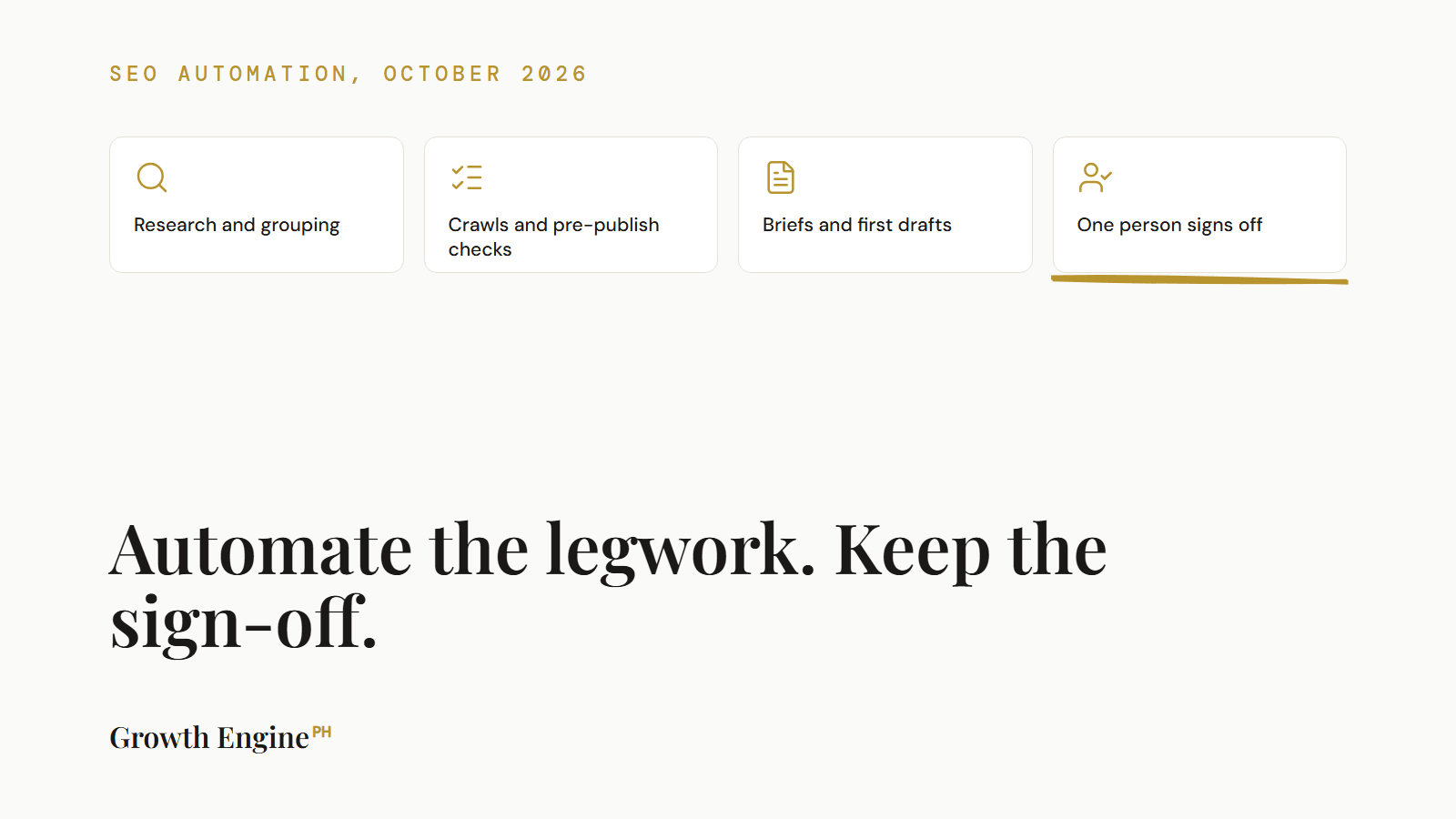
AI can run the gathering and first-pass work of SEO end to end: research, grouping, crawls, first drafts and pre-publish checks.
This is where the hours go, and it is fair to give automation full credit here.
Research and keyword grouping
Pulling search volumes, sorting thousands of keywords into topics, and spotting which pages compete for the same search used to take days. Software now does it in minutes. A person still checks that the groups make sense for the business.
Site crawls and audits
A crawl of a few hundred pages runs on its own and flags broken links, missing titles and slow pages. The list is reliable. Ranking which problems matter is still a person’s job.
Briefs and first drafts
If you are wondering how to use AI for SEO writing, this is the main answer. AI can read the pages that rank, summarize what they cover, and produce a first draft against a brief. It is a fast start. It is not a finished page.
Pre-publish checks
Before a post goes live, a script can count headings, images and FAQ items, test every link, and check that the title and description are set. This is the check that saved us in September. It is also the check that would have failed us, as the next section shows.
What goes wrong when automated SEO has nobody checking it?
Automated SEO fails quietly, because a tool that follows its instructions reports success even when the result is wrong.
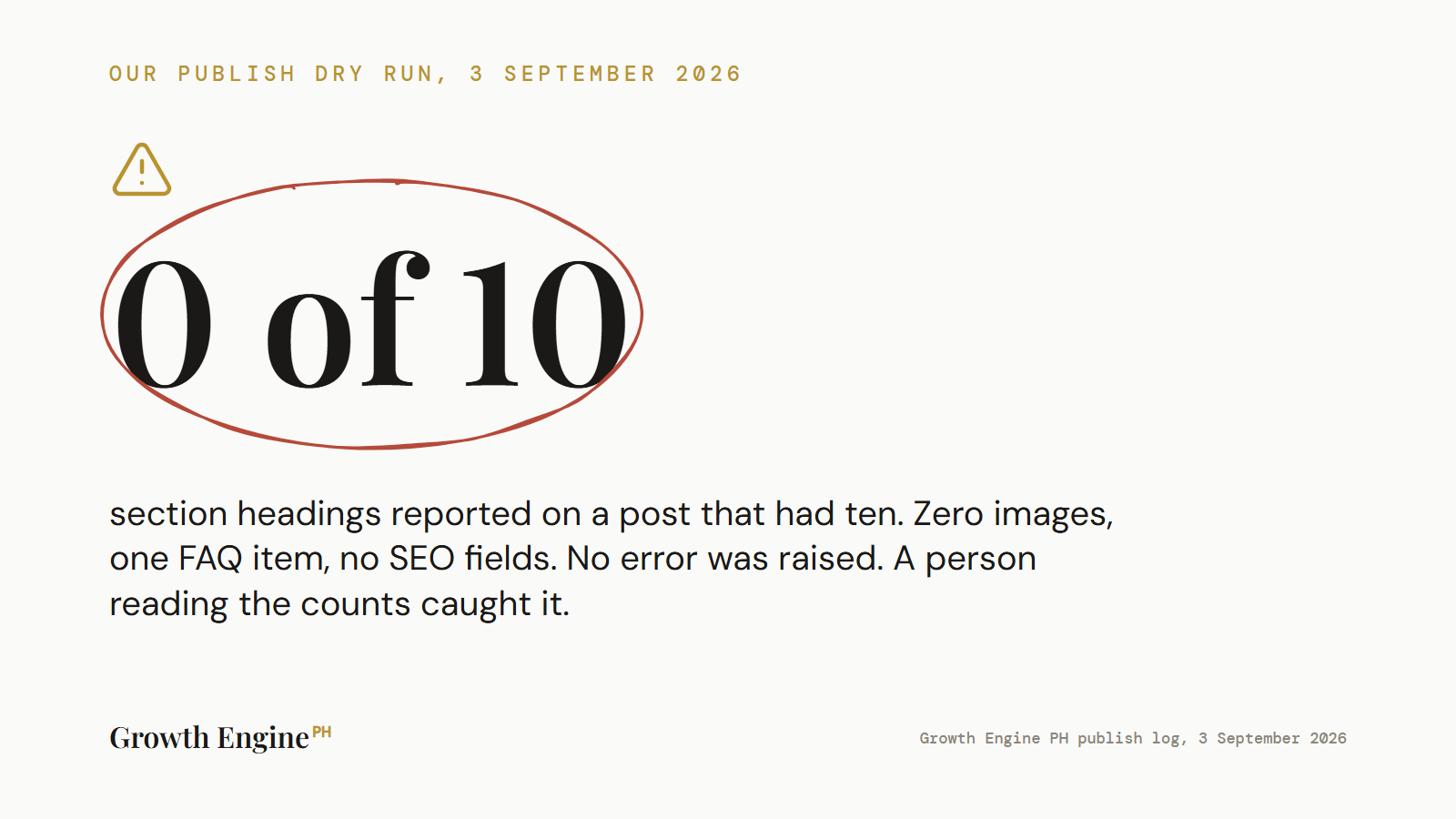
Here is our own example. Before publishing a post on 3 September, our publish tool did a dry run: a rehearsal that changes nothing and reports what it would do. The draft had ten section headings, three images, eight FAQ items and a full set of SEO fields. The dry run reported zero headings, zero images, one FAQ item and no SEO fields.
| What the dry run checked | In the draft | Reported by the tool |
|---|---|---|
| Section headings | 10 | 0 |
| Section images placed | 3 | 0 |
| FAQ items | 8 | 1 |
| SEO title and description | Set | None found |
Nothing failed. There was no error message. An edit earlier that day had changed the invisible line endings in the file, and the part of the tool that finds headings read the changed file as having none. Published as it was, the post would have gone live with no images and a one-item FAQ, and nothing would have warned us.
What caught it was not the tool. It was a person reading the counts against what the post should contain. That person had to know a post like this has about ten headings and eight FAQ items. The fix was one line of code. The lesson was not about code.
The second example is bigger. During Google’s September spam update, our daily rank tracker showed a Philippine law firm we work with falling from 18 keywords on page one to 1. Read on its own, that is a site being wiped out. Search Console, which is Google’s own record, showed daily clicks holding at about 51 the whole time. The tracker was returning blanks, not lower positions. We wrote up the tracker blanks in full.
An automated report would have sent the client the tracker’s number. Someone had to ask why two sources disagreed.
Practitioners report the same pattern. In an r/SEO thread on what can realistically be automated, one commenter put it this way: “Automation is a force multiplier. If your process is clean, it scales wins. If it’s messy, it scales mistakes.” (r/SEO) Another described taking on a site where rankings, clicks and conversions had all fallen after its previous SEO provider ran automation “with zero human intervention”. That is one person’s account, with no data attached, so treat it as a voice, not a statistic.
Should you hire an automation specialist or train your SEO lead?
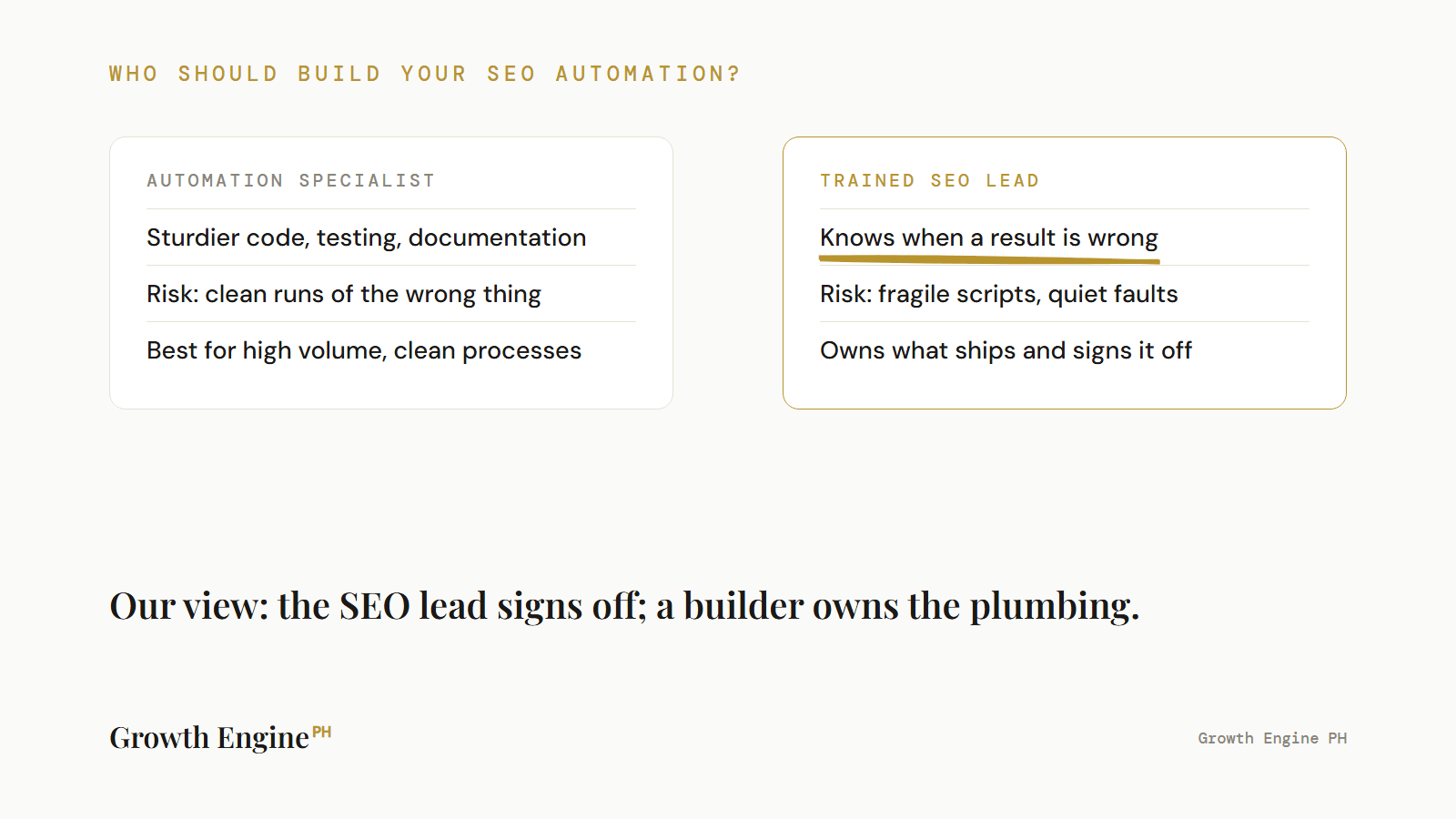
Train your SEO lead to automate first, and bring in a builder for the plumbing, because the costly errors are SEO errors that only an SEO person recognizes.
That is our view. Here are both sides.
The case for hiring an automation specialist
A specialist builds sturdier systems, with testing, logging and error handling an SEO lead often skips.
This is true often enough to take seriously. A person whose job is automation writes tests, records what each run did, handles errors on purpose and documents the system so someone else can run it. A script written by a busy consultant can work on their own machine and fail quietly anywhere else. Our line-endings error was exactly that kind of fault: a code-level problem a careful builder might have prevented.
Vendors in this space say it plainly. One automation platform’s guide puts it as “The specialist defines the playbook; the scenario executes it.” (Make, 1 July 2026) The same guide also says strategy, keyword choice and final approval “should stay with humans”. If your SEO is high volume and your processes are already clean, a specialist can save you a lot of hours.
The case for training your SEO lead
Firms that spread automation skills to domain experts have been found to get more value from AI than firms that keep them in one team.
That finding comes from a Management Science study of firms. Wharton’s summary of it (9 October 2025) reads: “Train domain experts, not just data scientists.” The study covers firms in general, not SEO, so take it as a direction, not proof.
The SEO-specific case is simpler. In our own work, the costly misses were SEO misses. A tracker read a healthy site as failing. An AI visibility count moved from 57 sources to 243 across seven weeks on the same 15 questions, with nothing changed on our side. Both were caught by someone who knew what a normal result looks like. A builder without SEO knowledge would have seen the code run cleanly and moved on.
Training has a real cost, and you should count it. Hours your SEO lead spends learning automation are hours not spent on client work. We built our own workflow as a consultant, not an engineer. That is one case, ours, so it proves the path is possible, not that it suits everyone.
| Hire an automation specialist | Train your SEO lead | |
|---|---|---|
| Strength | Sturdier code, testing, documentation | Knows when a result is wrong |
| Risk | Clean runs of the wrong thing | Fragile scripts, quiet code faults |
| Cost | A new salary or contract | Hours off client work while learning |
| Best when | High volume, processes already clean | Small team, judgment-heavy work |
| Our position | Bring one in for the plumbing | Owns what is automated and signs off |
What we would do
Let the SEO lead decide what to automate and sign off what ships, and let a builder own the plumbing.
If you can afford both, you get the specialist’s sturdier systems and the SEO lead’s judgment. If you can afford one, start with the person who can tell when the output is wrong. You can see how we scope this kind of work on our services page.
Who should sign off automated SEO work?
One named person who can read the output as an SEO should approve anything automated before it goes live.
The r/SEO thread says it in one line: “never auto-publish AI output. Put everything through a review queue with one accountable owner.” A review queue is a holding area where automated work waits until a person approves it.
What does that person check? Three things, and none needs code:
- Counts against expectation. Does the post have the headings, images and FAQ items it should? Does the report cover the keywords it should?
- Two sources compared. Does the rank tracker agree with Search Console? Does the AI visibility score agree with what changed on the site?
- What changed since last time. A big move with no cause on your side is a question to ask, not a result to send.
If no one on your team can answer those three, automation is not saving you time yet. It is moving the errors somewhere you cannot see them.
What does an AI-run SEO workflow look like, step by step?
In our practice, AI runs the research, drafts, crawls and pre-publish checks, and the consultant decides priorities and checks every number against a second source.
Here is the shape of it, with the human decision at each step:
- Research. AI pulls the keyword data, the ranking pages and real questions from forums. I decide which keyword the page targets and what angle it takes.
- Brief. AI builds the brief against a fixed template. I approve the angle and the outline before any writing starts.
- Draft. AI writes a first draft. I edit it, check every figure against its source, and cut anything we cannot back up.
- Checks. Scripts count headings, images, FAQ items and links before publishing. I read the counts against what the page should contain.
- Tracking. Rankings and AI visibility are captured on a schedule. I compare them with Search Console before anything goes in a report. Our full measurement method is published.
Automation does most of the hours. Every step still ends with a person who can say “that is wrong”. That is the whole model. Whether it lets one consultant serve more clients is a separate question, and we will answer it in a later post in this series.
Five questions to ask whoever runs your automation
Ask who signs off, what they check against, what happened the last time it failed, who can read the output, and what is never automated.
These work for an in-house hire, a freelancer or a provider.
- Who signs off before anything goes live? A good answer names one person. “The system checks it” is not an answer.
- What do they check it against? Listen for a second source, such as Search Console, or expected counts. “It looked fine” is a warning.
- When did it last fail, and how did you find out? Everyone’s automation fails. A good answer has a date and a fix. “It never fails” means no one is looking.
- Can the person who reviews it read it as an SEO? If the reviewer only checks that the code ran, no one is checking the result.
- What do you never automate? A good answer is specific: strategy, final approval, anything sent to a client. “Nothing” is the wrong answer.
If you want to see what is wrong before you decide who fixes it, start with a free SEO audit.
Frequently Asked Questions
What is SEO automation? SEO automation is using software, and now AI, to run repeatable SEO tasks such as keyword grouping, site crawls and reports without a person doing each step by hand. It runs the steps. It does not decide the strategy.
Can ChatGPT do SEO? An AI assistant can do much of the first-pass work: keyword ideas, outlines, first drafts and summaries of the pages that rank. It cannot decide who a page is for, or tell whether its own result is right. A person still has to do both.
Can I do SEO by myself? Yes, for the basics: clear titles, useful pages and a site that loads quickly. The harder part is knowing when a tool’s result is wrong. If you cannot check that, get a second opinion before acting on it.
Can a beginner do SEO? Yes. A beginner should learn the basics by hand before automating them. Automating a step you have never done means you cannot tell when it goes wrong.
Which SEO tasks are worth automating? The gathering and first-pass work: keyword research and grouping, site crawls, reports and pre-publish checks. Keep the decisions with a person: what to target, what to fix first and what gets published.
Should I hire an automation specialist or train my SEO person? Our view is to train the SEO person first, because the costly errors are SEO errors only they will spot. Bring in a specialist for the plumbing if volume justifies it. Either way, the SEO person signs off.
Is it safe to let AI publish SEO content automatically? No. Put automated work through a review queue with one named owner who checks it before it goes live. Our own publish tool once reported a ten-heading post as having none, and raised no error.
How do I tell if my provider’s automation is helping me? Ask who signs off, what they check against, and when it last failed. A provider who can answer all three with specifics is watching the output. One who cannot is trusting the tool.
Automate the Legwork, Keep the Sign-Off
SEO automation saves real hours, and we would not work without it. But the tool will do exactly what you told it. Someone has to know whether that was the right thing to ask, and whether the answer it gave back is true.
Hire for the plumbing if you need to. Never hand the sign-off to someone who cannot tell when the result is wrong. Start with a free SEO audit to see where your site stands first.