By Mark Buraga, Independent SEO Consultant at Growth Engine PH Last updated: 11 June 2026
Most content checklists tell you how to make a post better. This one tells you when not to publish it at all.
That distinction matters more than it used to. AI-assisted drafting made content cheap to produce and abundant, which means “good enough to publish” stopped being a meaningful bar. Volume went up across every site competing for the same queries, and the floor for hitting publish quietly dropped. The posts that fail now rarely fail on grammar or keyword placement. They fail because an engine cannot use them, or because they say nothing only that author could say.
There are eleven recurring ways a draft fails, and only a few of them have anything to do with the writing. The rest decide whether an engine can lift your content or whether it adds anything to a topic that is already saturated. Run them as gates, not tips: if a draft fails one of the decisive ones, it does not ship until it passes. Most of the eleven are catchable in minutes. The discipline of stopping is the entire point.
A gate, not a checklist
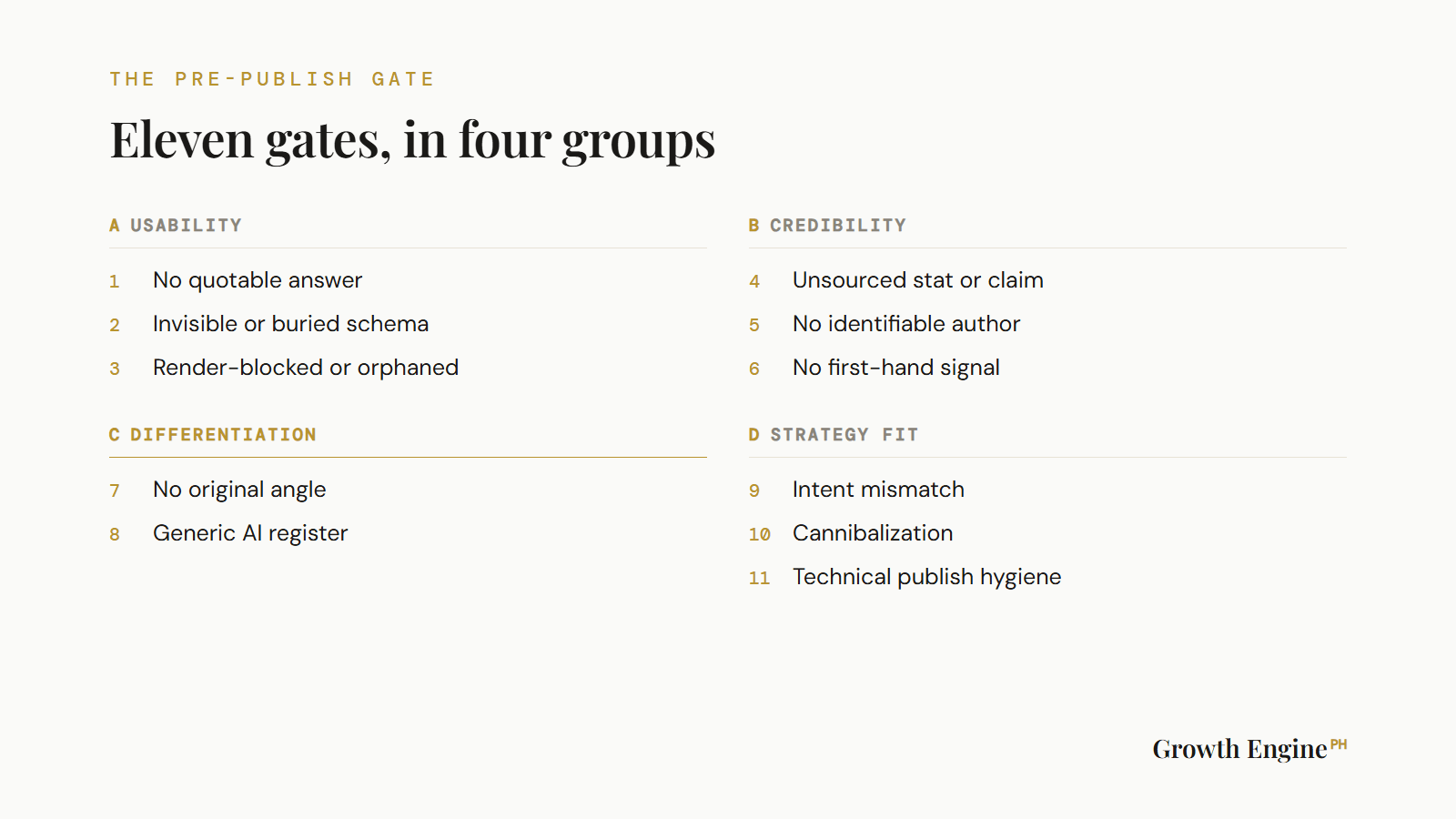
A content checklist tells you how to improve a post; a publish gate tells you when not to ship it, and in an era of abundant content the second discipline is the one that protects topical authority.
A checklist is something you consult and then publish anyway. A gate is binary: pass or fail, ship or hold. The reason to run a gate rather than a checklist is that shipping weak content is not neutral. Every thin post competes with your own stronger pages for the same intent, splits the signals that tell an engine which page to trust, and dilutes the topical authority that makes the good content rank. You are not just failing to add value. You are subtracting it.
The eleven gates fall into four groups, and the order is deliberate. Usability decides whether an engine can use the content at all. Credibility decides whether it can be trusted. Differentiation decides whether it deserves to exist next to everything already published. Strategy fit decides whether this particular post should be on your site. The cosmetic items most checklists obsess over sit in one short tail at the end. The load-bearing failures are usability and originality, and those are exactly the ones a keyword-and-readability checklist was never built to catch.
Group A – Usability: can an engine even use it
If no section opens with a self-contained answer and the schema is rendered by JavaScript, an AI engine has nothing to lift, so the content is invisible no matter how good it is.
This group is about retrievability. Before quality matters, the engine has to be able to fetch, parse, and extract the content. Fail any of these three and the rest of the work never gets seen.
Gate 1: No quotable answer. Block if no section opens with a self-contained answer. AI engines quote passages, not whole pages, and the most citable passages are short, fact-led, and make sense lifted straight out of the page, running somewhere around 134 to 167 words in our own testing. If your answer only resolves after three paragraphs of windup, the engine has nothing clean to extract and will quote whoever stated the same fact more directly. The fix is editing, not tooling: lead each section with the one-sentence answer, then support it underneath.
Gate 2: Buried or invisible structured data. Block if the page has no valid schema for its content type, or the schema is injected by JavaScript. Schema is how an engine confirms what a page is and who is behind it. But some AI crawlers do not execute JavaScript, so structured data added client-side is structured data the engine never sees. View the raw page source, not the inspector, and confirm the schema is in the HTML that comes back. Schema is the substrate that does this work, and it only counts if it is actually in the fetched markup.
Gate 3: Render-blocked or orphaned at publish. Block if the body is JavaScript-gated, or the post ships with no internal links in or out. Two separate problems share one consequence: the content exists but the engine cannot reach the substance of it. A JS-gated body is invisible to non-rendering crawlers. An orphaned post, one with no links pointing to it and none pointing onward, has no path for crawlers or readers to find it and no relationship to the rest of your site. A post nobody links to is a post you published into a void.
Group B – Credibility: can it be trusted
An unsourced statistic is the fastest way an AI-assisted draft loses credibility, and a post with no named author reads to an engine as published by nobody.
The engine can use the content. Now the question is whether it should trust it. This group is where AI-assisted drafts fail most often, because the things that make a draft fast to generate are the same things that strip out credibility.
Gate 4: Unsourced stat or claim. Block if any number or factual claim has no citation. This is the single fastest way an AI-assisted draft goes wrong, and it is worth a confession. Growth Engine PH runs every blog through a preflight gate before it goes live, and the gate has caught its own work. A draft once carried a clean, confident statistic with no source attached. The source-coverage check failed it, and when I traced the number back, it could not be verified, so it was cut rather than shipped. The sentence read perfectly. That was the danger. It was an unverifiable claim that would have quietly damaged credibility with both readers and the engines that weight sourcing, and the only reason it never went live is that a gate could say no. Every stat earns a source or it comes out.
Gate 5: No identifiable author or entity. Block if there is no named byline and no author or Organization schema. AI engines cite verifiable entities. A page that cannot prove who stands behind it reads as published by nobody in particular, and an engine routes around an author it cannot verify. A named byline, a Person object with a job title and an area of expertise, and an Organization the engine can resolve are the difference between a source and an anonymous page. This is the most common silent failure on otherwise competent sites.
Gate 6: No first-hand signal. Block if the draft contains zero experience, original example, or proprietary data. This is the test that AI-assisted content fails almost by definition unless you force it not to. A model can synthesize everything already written on a topic, but it cannot have done the thing. If a draft contains no first-hand example, no number you generated, no account of what actually happened when you ran the play, it is a summary of other people’s work wearing your byline. The fix is to add the one thing only you have: the result you got, the mistake you made, the data you collected.
Group C – Differentiation: does it say anything only you could say
Content that restates the consensus in a generic AI register adds nothing an engine would prefer to cite, because abundance makes sameness worthless.
This is the decisive group in the AI era, and the one no traditional on-page checklist grades. When content was scarce, restating the consensus competently was enough to rank. When content is abundant, it is invisible.
Gate 7: No original angle. Block if the draft restates the consensus and nothing in it is something a competitor has not already published. Before you publish, name the one claim, framework, or take in the piece that is yours. If you cannot, you are adding another copy of an answer the engine already has a hundred times. Originality does not mean contrarian for its own sake. It means a specific point of view, a named framework, a counter-case, or a piece of evidence that the rest of the page-one results do not have.
Gate 8: Generic AI register. Block if the draft reads like every other AI draft. There is a recognizable voice to ungoverned AI output: hedging qualifiers, filler transitions, paragraphs that summarize what was just said, confident sentences that commit to nothing. It is grammatically clean and completely forgettable. The tell is that you could swap your logo for a competitor’s and nothing would feel wrong. Read the draft out loud. If it sounds like a press release for an idea rather than a person making a point, it fails.
Group D – Strategy fit: should this post exist at all
A post that targets a query it doesn’t answer, or competes with a page you already rank with, should be retargeted or merged, not published.
The content is usable, credible, and original. The last group asks whether this specific post belongs on your site at all, and includes the one cosmetic tail every checklist already covers.
Gate 9: Intent mismatch. Block if the content does not actually answer the query it targets. A draft can be excellent and still target the wrong search. If the keyword implies the reader wants a comparison and the post delivers a definition, or implies they want to buy and the post explains, the page will not satisfy the query and will not hold a position even if it ranks briefly. Match the format to the intent behind the search, not just the words in it.
Gate 10: Cannibalization. Block if the post competes with a page you already rank with for the same query. Publishing a second page on a query you already own does not double your coverage. It splits it, forcing the engine to choose between two of your pages and often demoting both. Before you publish, check whether an existing page already targets this intent. If it does, the move is to strengthen and update that page or merge the new draft into it, not to ship a competitor to yourself.
Gate 11: Technical publish hygiene. Block if the title or meta is missing, links are broken, the hero is unoptimized, or the canonical is wrong. This is the cosmetic-but-mandatory tail. None of it will make a mediocre post succeed, but shipping with a missing title tag, dead internal links, a multi-megabyte hero image, or a canonical pointing at the wrong URL is shipping broken. It is the cheapest group to clear and the least excusable to skip, precisely because it takes minutes.
How to run the gate in five minutes
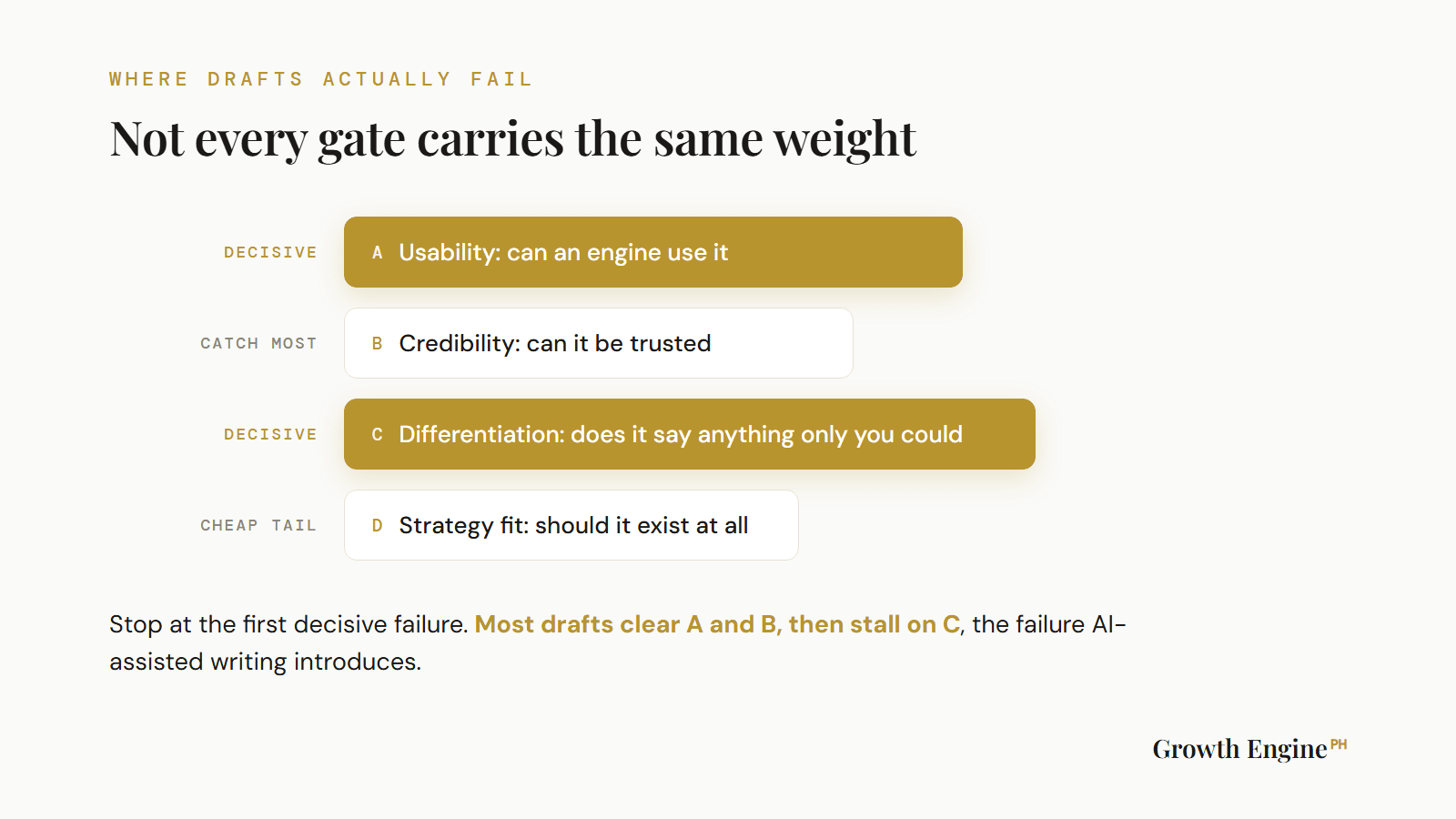
Run the eleven gates in order and stop at the first decisive failure, because a draft that fails usability or originality is not worth polishing until it passes.
The order is the method. Nine of the eleven are pass or fail in under a minute. Work top to bottom, and the moment a draft fails a decisive gate, in Group A or Group C, stop and fix that before touching anything cosmetic. There is no point tightening a headline on a post that says nothing only you could say, or optimizing a hero image on a post an engine cannot extract.
The pattern is consistent once you run it a few times. Most drafts clear Group A and Group B with small fixes. Where they stall is Group C, differentiation, because that is the failure AI-assisted production introduces and the one that takes real thought to close. That is also the good news: the gate that is hardest to pass is the one your competitors are not running, which means clearing it is the difference that compounds.
A content checklist tells you how to improve a post. A gate tells you when not to ship it, and the second discipline is what protects the first. The failures that matter are not in the prose. They are in whether an engine can use it and whether it says anything only you could say. If you cannot name the reason a post would get cited, that is the reason it will not be. Don’t ship it yet.
Engine runs every piece of content through this gate before it goes live, so the work that ships is the work that competes. If you are publishing steadily and seeing little for it, let’s talk.
FAQs
What should I check before publishing a blog post for SEO? Run a pre-publish gate in four groups. Usability: does each section open with a self-contained, quotable answer, and is the schema in the raw HTML? Credibility: is every stat sourced and is there a named author the engine can verify? Differentiation: is there an original angle, and does it avoid the generic AI register? Strategy fit: does it match the query’s intent and avoid competing with a page you already rank with? Hold the publish until the decisive groups pass.
Why does my content rank but not get cited by AI? Because ranking and citation have decoupled. Only 38 percent of AI Overview-cited pages also rank in the top 10 (Ahrefs), so a position no longer predicts a citation. The usual cause is a usability gap, an answer the engine cannot cleanly extract, rather than the quality of the writing. The six-block diagnostic covers the site-level version of this.
Is AI-written content bad for SEO? Not inherently. It fails when it ships unsourced, anonymous, generic, or without any first-hand signal, which are the exact shortcuts fast generation introduces. The gate exists to catch those before publish. AI-assisted content that carries a real point of view, verified sources, and original evidence competes fine.
What is content cannibalization? It is when two pages on your own site compete for the same query, splitting the intent and authority between them and often demoting both. The fix is to merge the weaker page into the stronger one or retarget it to a different query, rather than publishing two pages that fight each other.
How long should a citable passage be? Roughly 134 to 167 words, self-contained and fact-led. The most-cited passages state the answer first and put the support underneath, so an engine can lift them without needing the surrounding paragraphs to make sense of them.
How do I make content quotable for AI engines? Open each section with a one-sentence answer that stands on its own, then support it below. Keep the key passages short and fact-led, mark up the page with schema that lives in the raw HTML, and make sure a verifiable author and entity sit behind it. How AI engines decide who to cite goes deeper on the off-page half.