By Mark Buraga, Independent SEO Consultant at Growth Engine PH Last updated: 13 June 2026
Did AI change SEO, or is most of it hype? Both stock answers are wrong, and picking either one quietly wastes the next year of your effort.
Say everything changed and you chase every new tactic, relearn skills that were never broken, and abandon fundamentals that just got more important. Say nothing really changed and you keep running a workflow built for a results page that is being replaced, and wonder why steady work returns less every quarter. The useful question was never whether AI changed SEO. It is which workflows it reshaped, and at what level, so you know what to relearn and what to double down on.
Here is the honest split from running this work daily. Three SEO workflows were reshaped at the root. Two look exactly the way they always did, and those two now matter more than the three that changed. The skill the moment rewards is not collecting AI tactics. It is telling reshaped from unchanged.
Reshaped means the output changed, not the tool
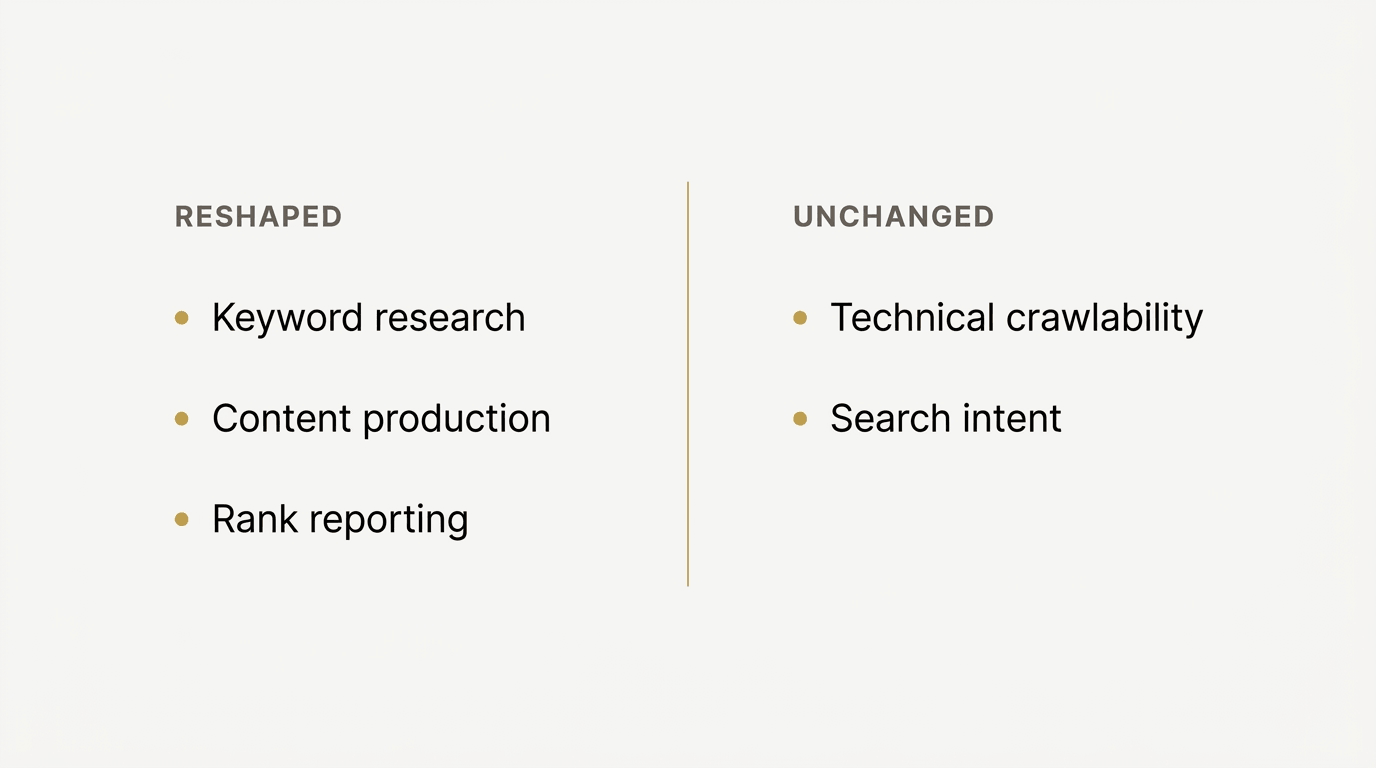
A workflow was reshaped when the thing it produces changed, not when it simply got a new tool, and that distinction is what separates the load-bearing changes from the noise.
This is the test the rest of this piece applies, so the split is principled rather than a matter of taste. Almost every workflow got a new tool in the last two years. A new tool is not a reshaping. Your rank tracker got an AI summary tab; your CMS got a draft button. If the job those tools serve is unchanged, the workflow is unchanged, and the “AI changed everything” advice attached to it is noise.
A workflow was genuinely reshaped only when its output changed: the deliverable it produces, the bottleneck it manages, or the metric it reports. By that test, three workflows changed at the root and two did not. Apply it yourself to any AI-SEO claim you read this year. If the underlying deliverable is the same, you are looking at a faster way to do the old job. If the deliverable is different, you are looking at a job you have to relearn.
Reshaped 1: Keyword research became entity and question mapping
Keyword research stopped producing a list of strings to rank for and started producing a map of the entities and questions an engine resolves into a single answer.
The old output was a spreadsheet: exact-match terms, search volume, a difficulty score, and a plan to build one page per worthwhile string. The work was matching. Find the words people type, place them on a page, rank for them.
The output is different now. AI engines resolve questions and entities, not strings. They cluster a dozen phrasings of the same need into one synthesized answer and pull from sources that establish the underlying entity and the relationships around it. Optimizing for string-match volume optimizes for a results page that is being replaced by exactly that synthesis. The deliverable that holds up is a map: the entities a topic touches, the questions a reader actually asks across the journey, and how an engine is likely to group them. The spreadsheet did not get a new column. It became a different document.
This is why the change is easy to miss. The tool still looks like keyword research, and volume still matters as a signal. But the job moved from collecting strings to modeling a topic the way an engine models it. What each acronym actually means covers the surfaces this maps onto, and the six-block diagnostic is the site-level version of the same shift.
Reshaped 2: Content production became verification and differentiation
When drafting became cheap and abundant, the scarce work moved downstream, so the bottleneck is no longer producing content but verifying and differentiating it.
For twenty years the constraint on content was production. Good writers were the bottleneck, briefs queued behind them, and the operating question was how to produce enough quality drafts to cover the map. Most of the workflow existed to feed that constraint.
AI-assisted drafting removed it. Producing a competent draft is now cheap, fast, and available to every competitor aiming at the same queries. When supply of “good enough” content goes effectively infinite, the value of producing it falls toward zero, and the scarce work moves downstream to judgment: sourcing every claim so nothing ships unverifiable, adding the first-hand signal a model cannot generate because it never did the thing, killing the generic register that makes one draft indistinguishable from another, and deciding what not to publish at all. That is a different workflow. The old one optimized for throughput. The new one optimizes for what survives a gate. We run every post through one, and the eleven failure modes that should block a publish are that reshaped workflow written down. The output stopped being “more drafts” and became “drafts that say something only this author could say.”
Reshaped 3: Rank reporting became multi-surface visibility
Position stopped predicting the outcome, so a positions-only report stopped describing reality, and the reshaped workflow tracks whether you are cited and mentioned across AI surfaces, not just where you sit in a list.
The old report was a list of positions. Keyword, rank, change since last month, a line about movement. It worked because position predicted the outcome: rank in the top few and you got the clicks, the leads, the result.
That link has loosened. Only 38 percent of pages cited in AI Overviews also rank in the top 10, down from around 76 percent eight months earlier (Ahrefs). When position no longer predicts whether you are the source an engine quotes, a report built only on position describes a world that is fading. The reshaped workflow tracks two more things: whether engines cite you as a linked source, and whether they mention you inside the synthesized answer even without a link. Those are different mechanisms and the difference is covered in the acronyms piece and in how engines decide who to cite.
The clearest proof I have is our own site. We track our AI visibility the way we tell clients to, not just positions but citations and mentions across surfaces. The first full read found we were cited and mentioned on every brand query and invisible on the non-branded discovery queries that actually win work. Known by name, absent on the terms a buyer searches. A positions-only report would never have surfaced that, because some of those non-branded terms were not ranking at all yet, so there was no position to track. The old metric could not see the problem the new one made obvious. That is the reshaped reporting workflow earning its place.
Unchanged 1: Technical crawlability, and why it matters more now
Technical crawlability looks exactly as it did, crawl the site, find what blocks access, fix it, but a machine that fetches raw HTML and does not execute JavaScript is far less forgiving than ten blue links ever were.
Now the other half, and it is the more important half. Technical crawlability was not reshaped. The workflow is identical to what it was a decade ago: crawl the site, find what stops a machine reaching and reading the content, fix it. Clean architecture, fast pages, markup a parser can read, no orphaned pages, no broken links. Nothing about that output changed.
What changed is the cost of getting it wrong. Many AI crawlers fetch raw HTML and do not run JavaScript, so content or schema injected client-side is content the engine never sees. An answer engine that lifts one passage and synthesizes a single response is less tolerant of a render-blocked page than a results list that could still show your link and let a human click through. The fundamentals did not survive the AI era as a consolation prize. They became the foundation everything else sits on, which is why schema that lives in the raw HTML is doing more work now than it ever did. If a machine cannot reach and read the page, none of the three reshaped workflows can help it.
Unchanged 2: Search intent, and why it matters more now
AI changed where the answer appears, not why a person searches or what satisfies them, so intent matching is the same discipline it always was, and a synthesized single answer is even less tolerant of a page that misreads it.
Search intent is the other workflow that did not move. The job is what it always was: work out what the searcher actually wants behind the words they typed, and match the page to it. Informational, commercial, transactional, navigational. AI did not change why people search or what would satisfy them when they do. It changed the surface the answer appears on.
If anything the discipline got stricter. Ten blue links forgave a near miss, because the reader could scan the list and self-correct to a better result. An engine that composes one answer does not give you that slack. A page that misreads intent does not get quietly skipped; it gets left out of the synthesis entirely. So the unchanged workflow carries more weight, not less. Getting intent right is no longer the thing that earns a slightly better position. It is part of what decides whether you are in the answer at all.
The skill is telling reshaped from unchanged
The real mistake is misclassifying, treating an unchanged fundamental as obsolete or an obsolete habit as a fundamental, and the operators who win can tell which workflow is which.
The decision rule is short: relearn the three workflows that were reshaped, and double down on the two that were not. Relearning means mapping entities and questions instead of stockpiling strings, building a production line that verifies and differentiates instead of one that just generates, and reporting on citations and mentions instead of positions alone. Doubling down means tightening crawlability and sharpening intent, because both now decide whether you make the answer at all rather than merely where you place in a list.
The failure mode is misclassification in either direction. Treat keyword research as unchanged and you optimize for a SERP that is dissolving. Treat technical SEO as obsolete because it feels old and you knock out the foundation the reshaped workflows depend on. Both errors look like confidence. Both cost you the year. The operators who compound over the next two years are not the ones who adopted the most AI tactics. They are the ones who could tell which part of the job actually changed, and acted on exactly that.
If you are doing steady SEO work and the returns keep thinning, the cause is usually a workflow misclassified: an old habit run as a fundamental, or a fundamental abandoned as old. Engine is built around the split in this piece, relearning the three that changed and doubling down on the two that did not. If that sounds like the gap you are in, let’s talk.
FAQs
Did AI actually change SEO, or is it hype? Both. Three SEO workflows were reshaped at the root: keyword research became entity and question mapping, content production became verification and differentiation, and rank reporting became multi-surface visibility tracking citations and mentions. Two workflows are unchanged, technical crawlability and search-intent matching, and both now matter more because a synthesized single answer is less forgiving than a list of links. The skill is telling the two groups apart.
What SEO skills do I need to relearn for the AI era? The three reshaped workflows. Map the entities and questions an engine clusters into one answer instead of building a list of exact-match strings. Build a content process that verifies and differentiates instead of one that only produces, since drafting is now cheap. And track whether engines cite and mention you across surfaces, not just where you rank.
Is technical SEO still relevant with AI search? More relevant, not less. Many AI crawlers fetch raw HTML and do not execute JavaScript, so crawlability, fast pages, and schema in the raw markup are less forgiving than before. The workflow looks the same as it always did; the cost of getting it wrong went up.
Does keyword research still matter in 2026? Yes, but the output changed. The deliverable that holds up is a map of the entities and questions a topic touches, modeled the way an engine groups them into an answer, rather than a spreadsheet of strings to rank for one page at a time. Volume is still a signal, not the plan.
Why does my page rank but not get cited by AI? Because position has decoupled from citation. Only 38 percent of pages cited in AI Overviews also rank in the top 10, so ranking no longer predicts being quoted. The usual cause is an extractability or sourcing gap rather than the writing. How AI engines decide who to cite covers the mechanism.
What is the difference between a citation and a mention in AI search? A citation is a linked source the engine attributes an answer to. A mention is your brand named inside the synthesized text, with or without a link. They are earned by different work, and tracking both is part of the reshaped reporting workflow. The acronyms piece breaks down the surfaces.